Image 1 of 2
1 / 2
© John Tann from Sydney, Australia, some rights reserved (CC-BY) · Wikimedia Commons
Platylobium, Genus, spp., Multiple species,
- Genus
- Multiple species
Flat-pea
Overview
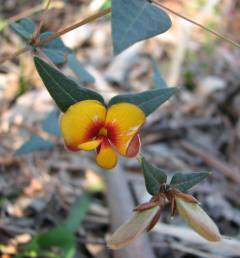
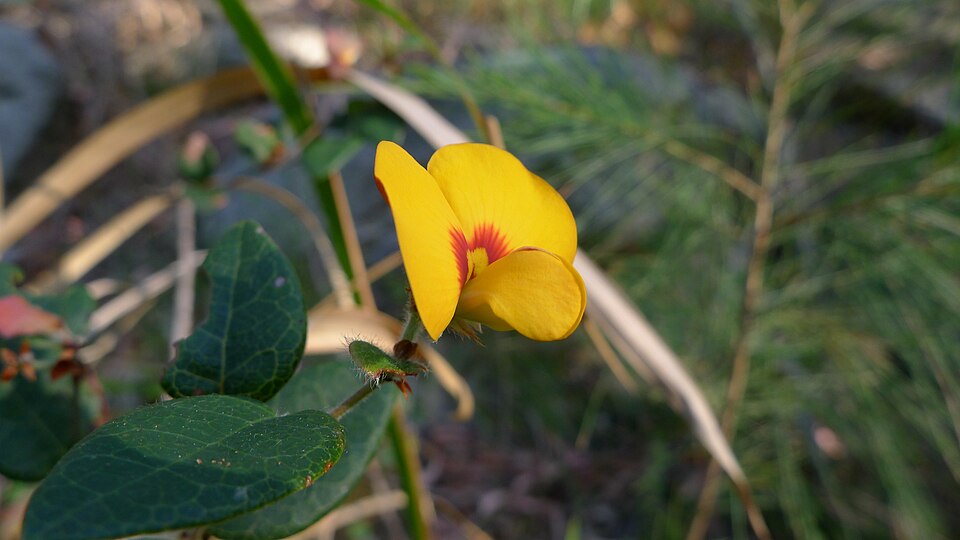
Platylobium is a genus of about ten evergreen shrubs and subshrubs in the pea family Fabaceae, endemic to southeastern Australia, where they grow in dry forest, woodland, and heath. Plants are wiry, sprawling to erect, 8-59 inches (20-150 cm) tall, with leathery leaves that are often heart-shaped or triangular and arranged in opposite pairs along the stems. The pea-shaped flowers are yellow to orange with reddish-brown markings on the standard petal, in the yellow-and-red pattern shared by many Australian peas, and appear singly or in small groups in the leaf axils. After flowering, the genus produces conspicuously flattened, winged pods, a feature behind the common name flat-pea. Platylobium grows on sandy, gravelly, or stony acidic soils that are low in nutrients and freely drained, and it fixes nitrogen through root nodules. It withstands dry spells and light frost but rots in heavy, wet, or fertile ground, which limits its garden use to native plantings, banks, and rockeries with sharp drainage.
Native Range
Platylobium is endemic to southeastern Australia, including New South Wales, Victoria, Tasmania, and South Australia. It grows in dry sclerophyll forest, woodland, and heath on acidic soils.Suggested Uses
Used in Australian native gardens, heath and woodland plantings, and on dry, sharply drained banks and rockeries. Suited to low-water and habitat gardens on sandy acidic soils.How to Identify
Appearance
Size & Dimensions
Height8" - 4'11"
Width/Spread1' - 4'
Bloom Information
Flowering occurs mainly in spring, roughly September through November in its native range, when stems carry yellow-and-red pea flowers in the leaf axils. Bloom lasts several weeks. Flat, winged pods ripen through late spring and summer.
Detailed Descriptions
Flower Description
Yellow to orange with red markingsFoliage Description
GreenGrowing Conditions
Sun Requirements
Requires 5-9 hours of direct sunlight daily
• Full Sun: 6+ hours of direct sunlight
• Partial Shade: 3-6 hours of direct sunlight
• Full Shade: Less than 3 hours of direct sunlight
Care & Maintenance
Care Guide
Grow Platylobium in full sun to light shade on light, sandy or gravelly, sharply drained acidic soil low in phosphorus, matching its forest-floor habitat. Water to establish, after which plants tolerate seasonal drought and resent waterlogging and phosphorus-rich fertilizers. Heavy or poorly drained soils bring on root rot, so raised or sloping ground suits the genus. A light trim after flowering keeps growth bushy. Most species tolerate light frost but are damaged by hard freezes. Propagation is from scarified seed or cuttings, and little feeding is needed beyond a low-phosphorus native blend if any.Pruning
Trim lightly after flowering to maintain a compact, branched habit. Cutting back into bare old wood often fails to reshoot, so pruning is kept within leafy growth. No heavy pruning is required.Container Growing
Suitable for container growing
Minimum container size: 3 gallons