Overview
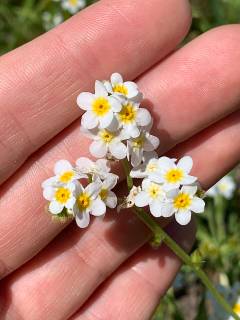
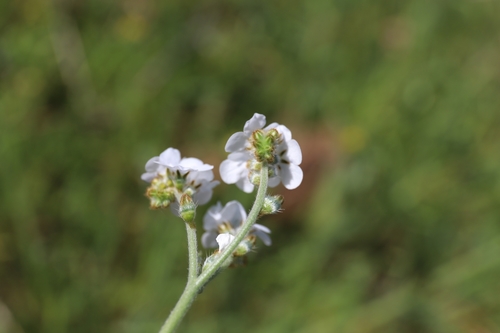
Plagiobothrys nothofulvus is a slender spring annual in the borage family (Boraginaceae), 4–16 inches (10–40 cm) tall, with one to several erect stems rising from a basal rosette. The narrow, oblong leaves are covered in stiff, spreading hairs, and the rosette and lower stem exude a purple to rusty-red dye that stains the soil, fingers, and the drying herbage — the source of the common name. Small white flowers, each about 0.2–0.3 inch (5–8 mm) across with five rounded lobes and a yellow center, open in coiled clusters that straighten as they bloom, resembling miniature forget-me-nots. It grows in open grassland, oak savanna, and the edges of vernal pools and seasonally moist flats, mainly in California and Oregon, flowering with spring rains and drying by early summer. The flowers are small and the plant is short-lived, fading once the soil dries. It reseeds each year, so a stand depends on fresh germination rather than persistent plants.
Native Range
Plagiobothrys nothofulvus is native to western North America, mainly California and Oregon, with scattered occurrences north to Washington and south into Baja California. It grows in grassland and oak woodland on seasonally moist soils.Suggested Uses
Plagiobothrys nothofulvus is used in native meadow, grassland, and vernal-pool-edge plantings and in restoration seed mixes on seasonally moist sites. Its early flowers add white to spring grassland and feed small native bees. It reseeds to maintain a stand from year to year.How to Identify
Appearance
Size & Dimensions
Height4" - 1'4"
Width/Spread3" - 8"
Bloom Information
White flowers open in spring, mainly March through May, on coiled clusters that straighten as the flowers open in succession. Bloom lasts roughly 6 weeks before the plant sets seed and dries. The small flowers are visited by early-season native bees.
Detailed Descriptions
Foliage Description
greenGrowing Conditions
Sun Requirements
Requires 6-12 hours of direct sunlight daily
• Full Sun: 6+ hours of direct sunlight
• Partial Shade: 3-6 hours of direct sunlight
• Full Shade: Less than 3 hours of direct sunlight
Water & Climate
Water Needs
Drought Tolerance
Drought tolerant when established