Picris, Genus, hieracioides, Species,
- Genus & species
hawkweed oxtongue
Europe, North Africa, and temperate Asia
Overview
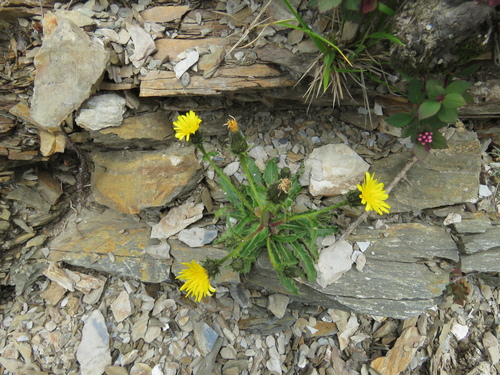
Picris hieracioides is a biennial or short-lived perennial in the daisy family, reaching 12-36 inches (30-90 cm) on stiff, branched stems. Stems and leaves are covered in rough, hooked bristles that catch on skin, giving a sandpapery texture. Basal leaves form a rosette 4-8 inches (10-20 cm) long, narrowly oblong with wavy or toothed margins, while stem leaves are smaller and clasp the stem. From July to September the plant carries yellow flowerheads 0.8-1.4 inches (20-35 mm) across, each composed entirely of strap-shaped ray florets and resembling a small hawkweed. The outer bracts are narrow and spreading, covered in blackish hooked hairs. Seeds are reddish-brown achenes topped with a feathery pappus that aids wind dispersal. The plant grows on roadsides, railway banks, chalk grassland, and disturbed ground, favouring calcareous soils. It self-seeds readily and colonises bare ground, though individual plants are short-lived. In cultivation it tolerates poor, dry soils but does not persist in dense, fertile borders where taller perennials shade it out.
Native Range
Native to Europe, North Africa, and temperate Asia, from the British Isles east to Siberia. In the British Isles it is most frequent in England and scarcer in Scotland and Ireland.Suggested Uses
Grown in wildflower meadows, chalk-grassland restoration, and naturalistic plantings on poor soils. The nectar-rich heads support pollinators in mid to late summer. It suits dry banks and verges where more demanding perennials struggle.How to Identify
Appearance
Size & Dimensions
Height1' - 3'
Width/Spread1' - 1'6"
Bloom Information
Flowerheads open from July to September, each lasting a single day and closing by afternoon. Blooming is staggered over several weeks as new heads form along the branched stems. Pollination is by bees, hoverflies, and other small insects visiting for nectar and pollen.
Detailed Descriptions
Foliage Description
greenGrowing Conditions
Sun Requirements
Requires 6-10 hours of direct sunlight daily
• Full Sun: 6+ hours of direct sunlight
• Partial Shade: 3-6 hours of direct sunlight
• Full Shade: Less than 3 hours of direct sunlight