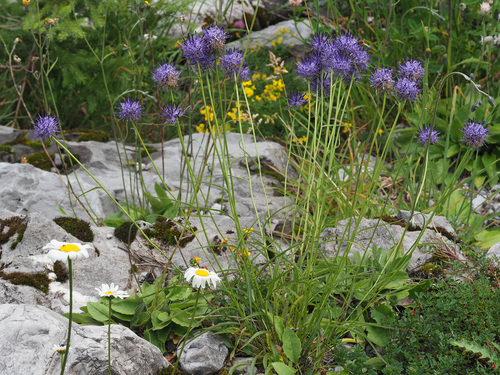
Phyteuma, Genus, scheuchzeri, Species,
- Genus & species
oxford rampion
Southern and central European Alps; rocky alpine slopes, alpine meadows, and mountain grasslands at elevations of 4,500-9,000 feet (1,400-2,700 m).
Overview
Phyteuma scheuchzeri is an alpine perennial in the bellflower family (Campanulaceae) that grows 8-16 inches (20-40 cm) tall and 8-12 inches (20-30 cm) wide as a clumping plant with a basal rosette of narrow lance-shaped leaves and slender flowering stems. Dense spherical flower heads 1-1.5 inches (2.5-4 cm) across composed of many deep blue to violet-blue individual flowers appear on the slender stems in May and June across a 3-week active flowering window. Each individual flower in the spherical head has a claw-like form in which the narrow petals are fused at the tips into a curved claw shape and split apart at the base, with the claws radiating outward from the spherical head in all directions; the architecture is not found in any other commonly grown garden perennial and the spherical head reads as a botanical curiosity at close viewing distance. The genus Phyteuma (rampions) belongs to the bellflower family Campanulaceae alongside the genus Campanula (true bellflowers) and Platycodon (balloon flower), but the spherical-head claw-flower architecture of Phyteuma is dramatically different from the open bell-shaped flowers of Campanula and the inflated five-pointed buds of Platycodon — the three genera in the family produce three substantially different flower forms despite sharing the family-level inflorescence chemistry and the family-shared milky latex sap (visible when stems or leaves are broken). The species was named after Johann Jacob Scheuchzer (1672-1733), the Swiss naturalist who documented Alpine flora and fauna in the early 18th century. Phyteuma scheuchzeri is native to the southern and central European Alps, growing on rocky alpine slopes, alpine meadows, and mountain grasslands at elevations of 4,500-9,000 feet (1,400-2,700 m) where the well-drained rocky substrate, the cool summer temperatures, and the long winter snow cover create the cultivation conditions that the species evolved with. The Alpine origin gives the species a strong preference for well-drained neutral to slightly alkaline soil and cool summer conditions; in hot humid climates (zones 7+), the plant struggles from the combination of summer heat and humidity that the species' Alpine native range does not include, and the species performs reliably only in zones 4-7 where summers are moderate. The claw-flower architecture and the spherical head form make the species a collector's plant that draws attention from gardeners who appreciate botanical-curiosity perennials over conventional border perennials. Deer avoid the foliage from the bitter-tasting Campanulaceae compounds.
Native Range
Phyteuma scheuchzeri is native to the southern and central European Alps, with a range concentrated in the high-mountain regions of Switzerland, Italy, France, Austria, and the surrounding Alpine countries. The species occurs on rocky alpine slopes, alpine meadows, and mountain grasslands at elevations of 4,500-9,000 feet (1,400-2,700 m), where the well-drained rocky substrate, the cool summer temperatures, and the long winter snow cover create the cultivation conditions that the species evolved with. The species is one component of the Alpine endemic flora and is encountered by hikers and climbers in the European Alps during the late-spring to early-summer flowering season at mid-mountain elevations.Suggested Uses
Used in rock gardens, alpine collections, scree gardens, alpine plant troughs and pans, and at the front of well-drained perennial borders where the small clumping habit and the brief late-spring bloom can be observed at close range. Container culture in shallow alpine pans of 1 gallon (3.8 liters) or larger works for the species' small root volume. The species is a collector's-plant addition to gardens with curated alpine and rock-garden plant collections; the spherical-head claw-flower architecture supplies a flower form not available from any other commonly grown garden perennial, and the form makes the species a recurring choice for gardeners who value botanical-curiosity perennials over conventional border perennials.How to Identify
Appearance
Size & Dimensions
Height8" - 1'4"
Width/Spread8" - 1'
Bloom Information
Dense spherical flower heads of deep blue to violet-blue claw-like individual flowers open on slender stems from May through June across a 3-week active flowering window. The bloom is brief relative to long-bloom border perennials, but the visual impact of the unrepeated spherical-head claw-flower architecture compensates for the short duration. Pollination is by bees and other insect pollinators that work the radiating claw flowers in the spherical head; the small Alpine bees of the species' native range are the principal pollinators in the wild.
Detailed Descriptions
Flower Description
Deep blue to violet-blue individual flowers carried in dense spherical heads 1-1.5 inches (2.5-4 cm) across on slender stems above the foliage rosette; each individual flower has a claw-like form in which the narrow petals are fused at the tips and split apart at the base, creating curved claw shapes that radiate outward from the spherical head — a flower architecture not found in any other commonly grown garden perennialFoliage Description
Medium green; narrow lance-shaped leaves arranged in a basal rosette and along the lower flowering stems, with the leaf form being characteristic of alpine Campanulaceae genera adapted to cool rocky habitatsGrowing Conditions
Sun Requirements
Requires 4-8 hours of direct sunlight daily
• Full Sun: 6+ hours of direct sunlight
• Partial Shade: 3-6 hours of direct sunlight
• Full Shade: Less than 3 hours of direct sunlight
Care & Maintenance
Care Guide
Plant in full sun to partial shade with 4-8 hours of direct light. Well-drained neutral to slightly alkaline soil at pH 6.0-7.5 supports the species; the species' Alpine rocky-substrate native habitat reflects a strong physiological preference for well-drained gritty soil and a low tolerance for heavy clay or wet-bottom positions where root rot develops. Fertilization is omitted because the Alpine native range is on lean rocky soils and the species does not benefit from added nutrients. Watering is during establishment and through summer dry spells, with moderate moisture being the right balance — neither dry nor wet. The principal cultivation limitation is climate rather than substrate: in hot humid climates of zones 7 and warmer, the species struggles from summer heat and humidity and behaves as a short-lived perennial; the species performs reliably only in zones 4-7 where summers are moderate. Where the climate is suitable, the species is low-maintenance because the small basal rosette and brief bloom period mean little active intervention is required across the season.Pruning
Spent flower heads are removed after bloom completes for tidiness, except where self-sowing is wanted (in which case the seed heads are left to mature and disperse). Foliage cleanup is in fall after the basal rosette browns. No other seasonal pruning is needed because the small clumping habit maintains itself at ground level.Pruning Schedule
Prune: July
summer
Container Growing
Suitable for container growing
Minimum container size: 1 gallons