Physostegia, Genus, virginiana, Species,
- Genus & species
obedient plant
Eastern and central North America (from Quebec south to Florida and west to Texas); moist meadows, stream banks, wet prairies, and pond margins.
Overview
Physostegia virginiana is a native eastern North American perennial in the mint family (Lamiaceae) called the obedient plant because each individual tubular flower on the dense four-sided terminal flower spike is attached to the square stem by a flexible hinge joint that allows the flower to be pushed left, right, up, or down on the spike and to stay where it is positioned, as if obeying the gardener's hand placement. The hinge mechanism is a botanical curiosity that makes the species a recurring choice for school garden plantings, public garden demonstration plantings, and gardeners who want a conversation-piece perennial that invites close inspection. The species grows 36-48 inches (90-120 cm) tall and spreads aggressively by stolons (short underground runners that emerge from the parent plant and root at the tip to form new daughter plants) to form expanding colonies that begin at 24-36 inches (60-90 cm) wide and continue to widen across multiple seasons in moist fertile soils. Pink to lavender-pink snapdragon-like tubular two-lipped flowers 1 inch (2.5 cm) long appear from August through October across a 5-week active flowering window — the late-season bloom fills the summer-to-fall transition gap when most other perennials in the surrounding planting have completed their flowering. The species is in the broader Lamiaceae mint family, sharing the square four-sided stem cross-section and the opposite leaf arrangement that the family carries as family-wide diagnostic characters with Mentha (mint), Salvia (sage), Nepeta (catmint), Lavandula (lavender), Thymus (thyme), and other aromatic Lamiaceae genera; unlike most other Lamiaceae genera, Physostegia foliage is not strongly aromatic and does not carry the strong essential-oil profile that many mint-family cousins use for chemical defense. The aggressive stoloniferous spreading habit is both the species' principal asset and its principal cultivation challenge: in naturalized meadow plantings, restoration plantings, and along stream banks where the spread is desirable, the species fills large areas quickly and supplies a strong late-season bloom; in formal cultivated borders, the spreading habit overtakes neighboring perennials within 2-3 seasons unless contained. In moist fertile soil, the stoloniferous spread is vigorous enough to qualify as invasive behavior at the planting-level scale (within a single garden), though the species is not classified as invasive at the regional ecological scale because it is a native species of the eastern North American range. Containment strategies include growing the species in a 7-gallon container, edging the planting position with a vertical root barrier 8-10 inches deep to block stolon spread, or choosing the non-spreading cultivar Miss Manners that breeds the aggressive stolon habit out of the species genome. The species tolerates wet and clay soils — among the few native perennials that thrives in poorly drained conditions where most border perennials decline from root rot. Deer avoid the foliage from the bitter Lamiaceae family compounds that the species shares with related mint-family genera.
Native Range
Physostegia virginiana is native to eastern and central North America, with a broad continuous range from southern Quebec and Ontario south through the eastern and central United States to Florida and west to Texas. The species occurs in moist meadows, stream banks, wet prairies, pond margins, and ditch edges across the native range, with the species' physiological preference for consistently moist soil conditions reflecting the wet-habitat origins. The species is a native component of the eastern deciduous forest meadow-margin and wetland-edge plant communities, and is a component of the historic tallgrass prairie wet-mesic plant community in the central United States.Suggested Uses
Used in naturalized meadow plantings, prairie restorations, rain gardens, along stream banks and pond edges, and in wet-soil garden positions where the aggressive stoloniferous spread is an asset rather than a problem and where the species fills the wet-soil ecological niche that most border perennials cannot handle. Container culture in 7-gallon or larger pots controls the spread for gardeners who want the obedient-flower mechanism in a confined space. The species is not suited to tidy formal borders without active containment because the spread overtakes neighboring perennials within 2-3 seasons. The obedient flower mechanism makes the species a recurring choice for school garden plantings, children's gardens, public garden demonstration plantings, and gardener-to-gardener show-and-tell where the flower-pushing demonstration invites close hands-on inspection.How to Identify
Appearance
Size & Dimensions
Height3' - 4'
Width/Spread2' - 3'
Bloom Information
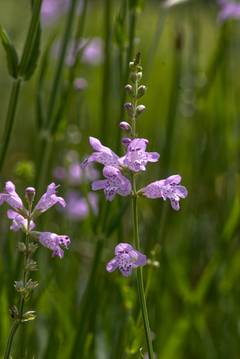
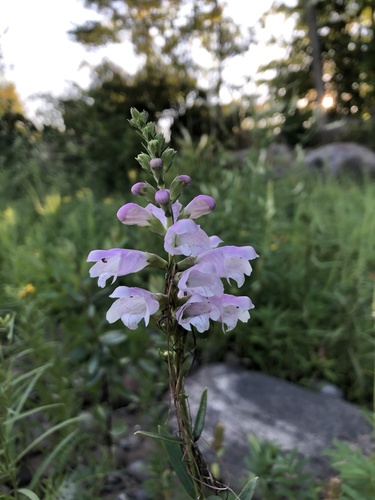
Pink to lavender-pink snapdragon-like tubular two-lipped flowers 1 inch (2.5 cm) long open in dense four-sided terminal spikes from August through October across a 5-week active flowering window. The late-season bloom fills the summer-to-fall transition gap when most other perennials in the surrounding planting have completed their flowering, making the species a recurring choice for late-season pollinator and cut-flower plantings. Pollination is by hummingbirds (which work the tubular two-lipped flower architecture and the warm-pink flower color), bumblebees and other large bees, and butterflies that visit for nectar through the long bloom window. Each individual flower lasts 5-7 days and the spike opens from the bottom upward across 2-3 weeks, producing the extended overall bloom from the staggered flower-opening sequence rather than from simultaneous bloom across the whole spike.
Detailed Descriptions
Flower Description
Pink to lavender-pink snapdragon-like tubular two-lipped flowers 1 inch (2.5 cm) long carried in dense four-sided terminal spikes, with each individual flower attached to the stem by a flexible hinge joint that allows the flower to be pushed left, right, up, or down on the spike and to stay where it is positioned — the source of the obedient plant common nameFoliage Description
Medium green; lance-shaped toothed leaves arranged in opposite pairs along the four-sided square stems that the mint family (Lamiaceae) shares as a family-wide character — the same square stems and opposite leaves seen in Mentha, Salvia, Nepeta, Lavandula, and other Lamiaceae generaGrowing Conditions
Sun Requirements
Requires 4-8 hours of direct sunlight daily
• Full Sun: 6+ hours of direct sunlight
• Partial Shade: 3-6 hours of direct sunlight
• Full Shade: Less than 3 hours of direct sunlight
Care & Maintenance
Care Guide
Plant in full sun to partial shade with 4-8 hours of direct light. Moist to wet soil with good organic content supports the species; the species' wetland-edge native habitat means consistently moist conditions and tolerance of clay and poor drainage that most border perennials cannot handle. The aggressive spreading habit requires active management for the species to coexist with neighboring perennials in cultivated borders: annual division (digging the clump in spring and replanting only the central section while removing peripheral stolon-borne daughter plants), vertical root barriers 8-10 inches deep around the planting position, or container culture in 7-gallon or larger pots are the principal containment strategies. Pinching the stems by one-third in early June produces shorter stockier plants with stronger stems that are less prone to flopping in late-summer rain; without pinching, the stems can reach 48 inches tall and may fall over from the weight of the flower spikes. Deadheading after bloom prevents self-sowing, which adds a second propagation route to the stoloniferous spread already occurring underground. All stems are cut to ground level in late November after frost browns the foliage. Cultivars selected for non-spreading habit (Miss Manners is the principal example) bypass most of the containment work for gardeners who want the obedient-flower mechanism without the aggressive spread.Pruning
Pinch stems by one-third in early June to produce shorter stockier plants with stronger stems. Deadhead spent flower spikes to prevent self-sowing in addition to the underground stolon spread. All stems are cut to ground level in late November after frost browns the foliage. Annual division in spring (replanting only the central clump section and removing peripheral stolon-borne daughter plants) is needed to contain the spreading habit in cultivated borders.Pruning Schedule
Prune: March, June & November
summerfallearly spring
Container Growing
Suitable for container growing
Minimum container size: 7 gallons