Pentaglottis, Genus, sempervirens, Species,
- Genus & species
green alkanet
Overview
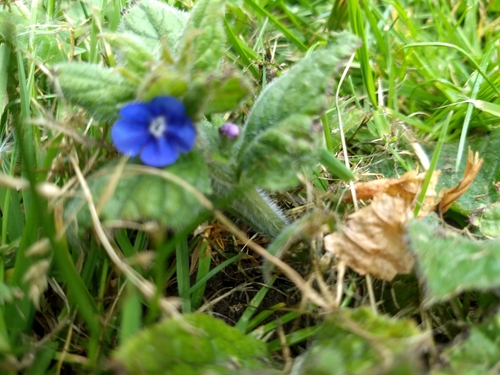
Pentaglottis sempervirens is an evergreen to semi-evergreen perennial in the borage family, forming a coarse clump 16–40 inches (40–100 cm) tall from a thick, deep, brittle taproot. The whole plant is covered in stiff bristly hairs. The large, pointed oval leaves are 4–16 inches (10–40 cm) long, net-veined and rough. From April to July it bears small bright blue flowers about 0.4 inch (10 mm) across, each with five rounded lobes and a white eye, carried in leafy coiled clusters. The plant self-seeds heavily and regrows from any fragment of the taproot left in the soil, which makes it hard to remove once settled. It grows in hedge banks, woodland edges, shaded walls, and waste ground, often near old gardens and dwellings. The roots yield a red dye, the source of the name alkanet. It stays green through mild winters and dies back only in hard frost.
Native Range
Native to south-western Europe, in Spain, Portugal, and south-western France, and widely naturalized across western and northern Europe. It grows in shaded hedge banks, woodland margins, roadsides, and disturbed ground near habitation.Suggested Uses
Used in shaded wild gardens, woodland edges, and informal banks where its spread is wanted. Suited to dry shade under trees and beside north-facing walls. Grown as an early nectar source for bees in naturalistic and wildlife plantings.How to Identify
Appearance
Size & Dimensions
Height1'4" - 3'4"
Width/Spread1'6" - 2'6"
Bloom Information
Detailed Descriptions
Flower Description
bright blue with white eyeFoliage Description
deep greenGrowing Conditions
Sun Requirements
Tolerates up to 4 hours of direct sunlight daily
• Full Sun: 6+ hours of direct sunlight
• Partial Shade: 3-6 hours of direct sunlight
• Full Shade: Less than 3 hours of direct sunlight
Care & Maintenance
Care Guide
Grows in part shade to full shade on moist, fertile soils with a pH of 5.5–7.5, and tolerates dry shade once the taproot is deep. It grows in almost any soil and spreads freely by seed and root. No feeding or watering is needed. The deep taproot resists removal, and any piece left behind regrows, so it is sited where its spread is acceptable. Hardy in USDA zones 6 to 8. Cutting plants back before seed sets is the main way to limit its colonisation.Pruning
Flowering stems are cut back after bloom to limit the heavy self-seeding. Plants are cut to the ground in late autumn, though the rosette often stays green. Digging out the entire taproot is needed to remove a plant, as cut roots resprout.Pruning Schedule
Prune: July & November
summerfall