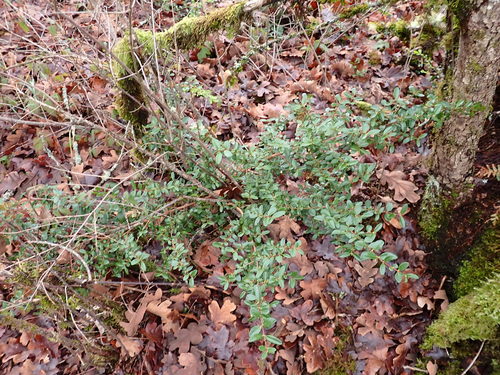
Paxistima, Genus, myrsinites, Species,
- Genus & species
Oregon Box
Overview
Paxistima myrsinites is a low-growing evergreen shrub reaching 12-24 inches (30-60 cm) tall and 2-4 feet (60-120 cm) wide at maturity, with a dense, mounding habit. Stems are slender, four-angled in cross-section, and densely set with leaves. Leaves are opposite, narrowly elliptic to oblong, 0.4-1 inch (1-2.5 cm) long, leathery, dark glossy green year-round, with toothed margins on the upper half. Small four-petaled red-brown flowers 0.1-0.2 inches (3-5 mm) across appear in clusters of 1-3 from leaf axils in May and June; flowers are partially hidden by foliage and self-pollinating. Fruit is a small leathery capsule 0.15 inches (4 mm) long containing 1-2 seeds, ripening in August and September. Growth is slow at 2-4 inches (5-10 cm) per year; plants reach mature size in 8-12 years and live 30-50 years. Plants spread slowly by short rhizomes and layering where lower branches touch soil. Despite the boxwood-like appearance and common name, the plant is in the Celastraceae (bittersweet family), not the Buxaceae (true boxwoods).
Native Range
Native to western North America from southeast Alaska south through British Columbia, Washington, Oregon, and California, east to Idaho, Montana, and Utah. Found in coniferous forest understory, on rocky slopes, and along stream margins at 2,000-9,000 feet (600-2,750 m) elevation. Most common on well-drained, acid soils derived from volcanic or granitic substrate in zones with cool summers.Suggested Uses
Used as a ground cover in shaded native plant gardens, as a low evergreen edging in woodland borders, and on shaded slope plantings in zones 5-8 at 30-36 inch (75-90 cm) spacing. Year-round dark glossy green foliage holds form through winter snow loads of 1-2 feet (30-60 cm). Container culture is possible in pots of 5-7 gallons (19-26 L) with acid potting media and consistent moisture; growth is slower than in-ground specimens.How to Identify
Appearance
Size & Dimensions
Height1' - 2'
Width/Spread2' - 4'
Bloom Information
Small four-petaled red-brown flowers 0.1-0.2 inches (3-5 mm) across appear in clusters of 1-3 from leaf axils in May and June. Bloom lasts 2-3 weeks at any single site. Flowers are 0.1-0.2 inches (3-5 mm) wide and partially hidden by foliage; seed capsules ripen August through September.
Detailed Descriptions
Foliage Description
dark glossy greenGrowing Conditions
Sun Requirements
Tolerates up to 6 hours of direct sunlight daily
• Full Sun: 6+ hours of direct sunlight
• Partial Shade: 3-6 hours of direct sunlight
• Full Shade: Less than 3 hours of direct sunlight
Care & Maintenance
Care Guide
Grows in part shade to full shade on well-drained acid soils high in organic matter; tolerates dry shade under conifers in zones 5-8. Water weekly during establishment; mature plants survive on natural rainfall in zones 6-8 with summer rainfall above 15 inches (38 cm). Plants decline rapidly on alkaline soils with pH above 7.0 and on heavy clay. Browse from deer and elk shapes wild plants in winter but the colony resprouts from the crown after browse damage. Few pest problems are recorded; plants in dense shade can develop sooty mold on leaves where insect honeydew falls from overhead trees. Lifespan is 30-50 years on suitable sites.Pruning
No regular pruning is required; the dense, mounding form is maintained by the plant's growth habit. Light shaping can be done in late spring after the small flowers fade by tipping back wayward stems with hand pruners. Heavy pruning to within 6 inches (15 cm) of the ground rejuvenates declining 25+-year-old plants and is tolerated, with full regrowth taking 4-6 years.Pruning Schedule
Prune: June
late spring
Container Growing
Suitable for container growing
Minimum container size: 5 gallons