Palmaria, Genus, palmata, Species,
- Genus & species
dulse
North Atlantic and North Pacific coasts
Overview
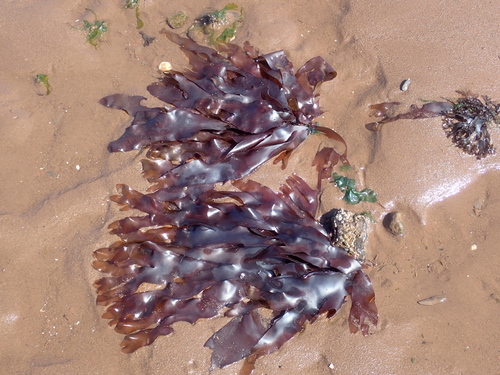
Palmaria palmata is a red marine alga forming flattened, membranous fronds 4–20 inches (10–50 cm) long and 1–3 inches (3–8 cm) wide. The fronds attach to rock or to the stipes of larger kelps by a small discoid holdfast, then broaden into a leathery blade that divides palmately into several segments. Coloration ranges from deep reddish-purple to red-brown, fading toward yellow at the margins in strong light. The species grows in the mid- to low-intertidal and shallow subtidal zones of cold North Atlantic and North Pacific coasts, where it tolerates repeated exposure to air at low tide and submersion in cold, fully marine water. It lacks roots, stems, and leaves, and absorbs nutrients directly across the frond surface. Growth is fastest in winter and spring water temperatures of 41–50°F (5–10°C), and fronds erode from the tips through summer. Palmaria palmata has been harvested as food along the coasts of Ireland, Iceland, and Atlantic Canada, where it is dried and eaten as dulse. It does not survive in warm water above about 68°F (20°C), which restricts it to high-latitude shores and limits its use in temperate aquaria or warm coastal sites.
Native Range
Palmaria palmata occurs on rocky shores throughout the cold-temperate and subarctic North Atlantic, from the eastern seaboard of North America to the coasts of Europe, and along parts of the North Pacific. It is native to both North American and European coastlines.Suggested Uses
Harvested as an edible sea vegetable, dried for human food, and used as a feed supplement for livestock along North Atlantic coasts. In marine aquaculture it is grown on ropes or in tanks alongside fish and shellfish.How to Identify
Appearance
Size & Dimensions
Height4" - 1'8"
Width/Spread1" - 3"
Bloom Information
Reproduction is by spores rather than flowers, so no blooming occurs. Spore release takes place chiefly in autumn and winter, when mature fronds shed reproductive cells into the water. The species produces no flowers, cones, or seeds.