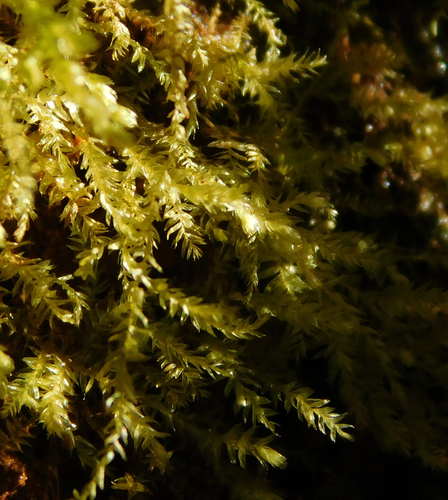
Oxyrrhynchium, Genus, spp., Multiple species,
- Genus
- Multiple species
beaked feather-moss
Northern Hemisphere temperate and montane regions
SunPart Shade – Full Shade
WaterHigh
Overview
Oxyrrhynchium is a genus of pleurocarpous mosses in the family Brachytheciaceae, growing as creeping mats on soil, rock, tree bases, and rotting wood in shaded, humid sites across temperate regions. The slender stems are irregularly to pinnately branched and spread horizontally, forming loose green to yellow-green wefts a few centimeters deep. Leaves are egg-shaped to triangular, 0.04 to 0.1 inch (1 to 2.5 mm) long, tapering to a narrow point, with a single midrib reaching about two-thirds of the leaf and small teeth along the margin. As with other mosses, the genus lacks true roots, flowers, and conducting vessels, anchoring instead by thread-like rhizoids and absorbing moisture across its surface. Spore capsules are borne on a reddish stalk and sit inclined to horizontal, with a beaked lid that gives the genus its name. Reproduction occurs by spores released from the capsule and by fragmentation of the shoots. The genus favors consistently moist, low-light habitats such as stream banks, woodland floors, and shaded masonry, and is sensitive to drying and air pollution. It is separated from related mosses by leaf shape, the beaked capsule lid, and cell details seen only under magnification.
Native Range
Oxyrrhynchium occurs widely across temperate and montane regions of the Northern Hemisphere, including Europe, Asia, and North America, with some species in the Southern Hemisphere. It colonizes shaded, damp substrates such as soil banks, rock, tree bases, and decaying wood.Suggested Uses
Oxyrrhynchium is used in shaded moss gardens, terrariums, and on damp rockwork and walls where a low green carpet is wanted. It stabilizes the surface of moist soil banks and shaded ground. The genus suits naturalistic and woodland plantings rather than dry or sunny sites.How to Identify
Appearance
Bloom Information
As a moss, Oxyrrhynchium does not flower. Spore capsules mature mostly through autumn and winter in temperate climates, releasing spores once the beaked lid falls away. Timing shifts with local moisture and temperature.
Detailed Descriptions
Foliage Description
green to yellow-greenGrowing Conditions
Sun Requirements
Tolerates up to 4 hours of direct sunlight daily
• Full Sun: 6+ hours of direct sunlight
• Partial Shade: 3-6 hours of direct sunlight
• Full Shade: Less than 3 hours of direct sunlight
Water & Climate
Water Needs
Care & Maintenance
Care Guide
Oxyrrhynchium grows in continuously moist, shaded to partly shaded sites with high humidity and soft, slightly acidic to neutral substrates. It needs no fertilizer or soil cultivation, drawing moisture and minerals directly through its surface. In moss gardens or terrariums it requires steady moisture, shelter from direct sun, and clean air, as it reacts poorly to pollutants and prolonged drying. Established mats spread on their own and propagate from fragments pressed onto a damp surface. Excess heat and standing water both cause the mats to thin and brown.Pruning
No pruning is needed. Mats can be lifted, divided, and re-laid to manage spread or to start new patches. Clearing fallen leaves and debris keeps the surface open and prevents smothering in autumn.Container Growing
Suitable for container growing
