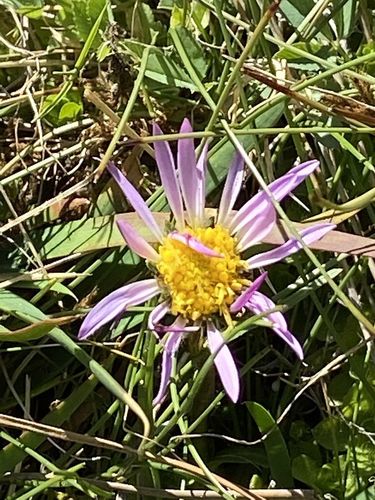
Oreostemma, Genus, alpigenum, Species,
- Genus & species
alpine aster
Western North American mountain ranges (Cascades, Rockies, Sierra Nevada)
Overview
Oreostemma alpigenum is a low cushion-forming herbaceous perennial in the aster family, reaching 4-12 inches (10-30 cm) tall in flower with a basal mat of foliage 4-8 inches (10-20 cm) wide. Leaves narrow and grass-like, mostly basal, 1-4 inches (2.5-10 cm) long and 0.1-0.25 inch (2.5-6 mm) wide, dark green with a single prominent vein. Flower heads solitary on leafless or sparsely-leafed stems 4-12 inches (10-30 cm) tall, 1-1.5 inches (2.5-3.8 cm) across, with 12-25 violet to lavender ray florets surrounding a yellow disk. Bloom occurs from late June through August at high elevations. Spreads by short rhizomes to form mats 8-12 inches (20-30 cm) across in 4-6 years. Foliage remains green into late autumn at sub-alpine sites and persists as senescent tufts under snow cover. Plants resent the warm humid summers of low-elevation gardens and decline rapidly outside cool montane conditions.
Native Range
Native to alpine and sub-alpine meadows, rocky slopes, and snow-melt margins in mountain ranges of western North America from southern British Columbia and Alberta south through Washington, Oregon, Idaho, Montana, Wyoming, Utah, and Colorado, generally at elevations of 5,000-12,000 feet (1,500-3,650 m).Suggested Uses
Used in rock gardens, troughs, alpine houses, and high-elevation native plant collections at 8-12 inch (20-30 cm) spacing in zones 4-7 cool-summer climates. Combines with Penstemon davidsonii, Phlox diffusa, and other cushion alpines in scree plantings. Containers require sharply drained gritty mix in pots of at least 1 gallon (3.8 L); ordinary potting mix retains too much moisture and rots crowns within one growing season.How to Identify
Appearance
Size & Dimensions
Height4" - 1'
Width/Spread8" - 1'
Bloom Information
Late June through August across the species range, with peak bloom in mid-July at most sites. At highest elevations, bloom may extend into early September. Individual flower heads last 10-14 days; clumps produce sequential heads over 4-6 weeks. Hot dry conditions shorten the bloom period by 1-2 weeks.
Detailed Descriptions
Flower Description
Violet to lavender with yellow diskFoliage Description
Dark green, grass-likeGrowing Conditions
Sun Requirements
Requires 6-12 hours of direct sunlight daily
• Full Sun: 6+ hours of direct sunlight
• Partial Shade: 3-6 hours of direct sunlight
• Full Shade: Less than 3 hours of direct sunlight
Care & Maintenance
Care Guide
Establishes from container stock or seed in 1-2 growing seasons in well-drained gritty alpine soils. Mature plants tolerate brief drought once established but require winter snow cover or insulating mulch in lowland zone-7+ gardens; bare crowns die in mid-winter freeze-thaw cycles below 20 degrees F (minus 7 C). Crown rot occurs in heavy clay or in sites that stay wet through summer. Foliage scorches at sustained temperatures above 80 degrees F (27 degrees C) without afternoon shade or root cooling. Slugs and snails feed on emerging spring growth in moist gardens but are absent at native montane sites. Plants are short-lived (3-5 years) outside their native cool elevation.Pruning
Cut spent flower stems at the base in late summer after seed dispersal. Tattered foliage is removed in early spring before new growth emerges. The cushion form does not require shaping; cutting back live leaves into woody crowns rarely results in regrowth.Pruning Schedule
Prune: March & September
early springfall
Container Growing
Suitable for container growing
Minimum container size: 1 gallons