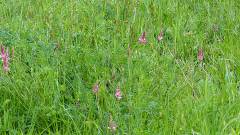
Onobrychis, Genus, viciifolia, Species,
- Genus & species
sainfoin
Overview
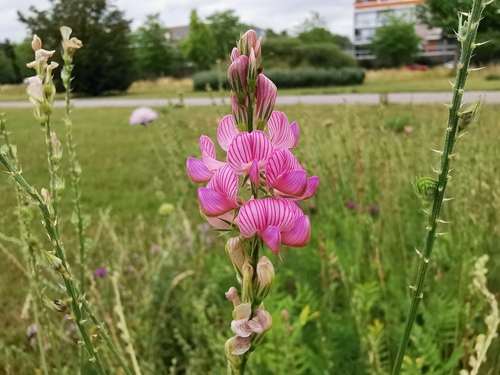
Onobrychis viciifolia is an upright herbaceous perennial legume growing 1-3 feet (30-90 cm) tall from a deep taproot. Stems are erect and branched, bearing pinnately compound leaves 3-6 inches (8-15 cm) long with 6-14 pairs of oblong leaflets. Pea-shaped flowers, bright pink to rose with deeper red veining and about 0.4 inch (10 mm) long, are packed into dense conical racemes 2-6 inches (5-15 cm) long on stalks held above the foliage from late May to July. Each flower yields a single flattened, sculptured, one-seeded pod roughly 0.3 inch (6-8 mm) across. The deep root system draws moisture from depth and fixes atmospheric nitrogen through rhizobial nodules. Foliage dies back in autumn and regrows from the crown in spring. Stands are shorter-lived than many forage legumes, thinning after 3-4 years. Condensed tannins in the foliage prevent pasture bloat in grazing ruminants. The species needs free-draining, lime-rich ground and fails on acidic or waterlogged soils.
Native Range
Native to temperate Europe and western Asia, from Spain and Britain east across the Caucasus into central Asia. It grows on dry calcareous grassland, chalk downs, and rocky slopes, and has been cultivated and naturalised widely as a forage crop.Suggested Uses
Grown as a forage and hay legume for livestock, as a nectar source in pollinator and conservation seed mixes, and on chalk-grassland restoration sites, sown at 1-2 inch (2.5-5 cm) spacing in drills. Suited to dry, alkaline soils where clovers and alfalfa grow poorly. Not productive on acidic or wet ground.How to Identify
Appearance
Size & Dimensions
Height1' - 3'
Width/Spread1' - 2'
Bloom Information
Flowers from late May through July, with the main flush in June. Individual racemes open over 1-2 weeks from the base upward, and a stand blooms for 3-5 weeks. A light second flush can follow cutting in late summer where moisture allows.
Detailed Descriptions
Flower Description
pink with red veiningFoliage Description
greenGrowing Conditions
Sun Requirements
Requires 6-10 hours of direct sunlight daily
• Full Sun: 6+ hours of direct sunlight
• Partial Shade: 3-6 hours of direct sunlight
• Full Shade: Less than 3 hours of direct sunlight
Care & Maintenance
Care Guide
Grows in full sun on free-draining, neutral to alkaline soils, including thin chalky and stony ground. Deep roots make established plants drought-tolerant, and the species fixes its own nitrogen, so no feeding is required. It does not tolerate acidic, compacted, or waterlogged soils, where it rots and dies out. Sown from seed in spring or late summer, stands establish in the first year and reach full yield in the second. Productivity declines after 3-4 years as plants thin, and patches are resown to maintain cover. Few pests trouble it, though crown and root rots occur in wet ground.Pruning
Cut for hay or forage at early bloom, leaving 2-3 inches (5-8 cm) of stubble so the crown can regrow. A single annual cut suits ornamental and conservation plantings, taken after seed has set for self-renewal. No other pruning is needed.Pruning Schedule
Prune: June–July
summer