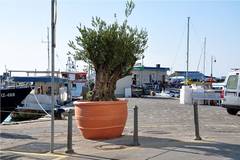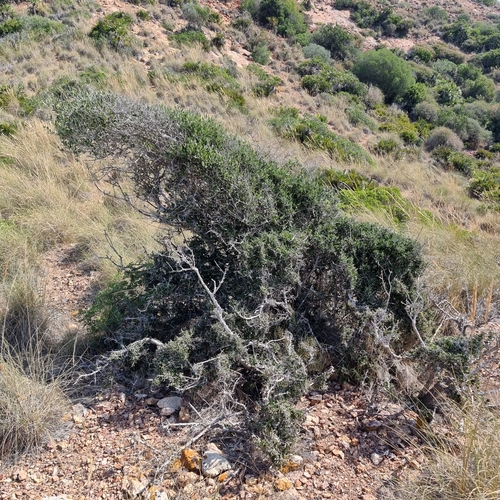
Olea, Genus, europaea, Species,
- Genus & species
olive tree
Mediterranean basin (the broader range encompasses southern Europe from Portugal east to Greece and Turkey, North Africa from Morocco east to Egypt, and the Middle East from Lebanon south to Israel and Jordan); hot-summer dry-summer climate zones with rocky calcareous substrate, full-sun exposure, and limited summer rainfall.
Overview
Olea europaea is the olive tree (also called European olive), an evergreen tree in the olive family (Oleaceae) growing 10-30 feet (300-900 cm) tall and wide as an outdoor tree across the species' cold-hardy range, and 4-8 feet (120-240 cm) tall in container culture used for indoor-overwintering in cold-zone gardens. The species has been continuously cultivated for 6,000 to 8,000 years and is among the earliest-cultivated tree species in the human agricultural record — domestication of Olea europaea began approximately 6,000 to 8,000 years ago in the eastern Mediterranean basin, and the species has been continuously cultivated for olive oil and table-olive production across the Mediterranean civilizations from the ancient Egyptians, Phoenicians, Greeks, and Romans through the medieval and modern periods to present-day commercial cultivation. The species' principal physical character is the silver-green to gray-green small narrow leathery evergreen foliage 1-3 inches (2.5-7.5 cm) long arranged in opposite pairs along the branches; the leaf undersides are lighter silver-white with dense scaly indumentum that scatters incident light to produce the characteristic two-toned silver effect when wind moves the foliage, and the gray-green foliage color combined with the gnarled sculptural trunk character that develops over decades to centuries together define the iconic Mediterranean landscape aesthetic that the species has come to represent in horticultural and cultural contexts. Mature specimens of O. europaea can live for over 2,000 years — some living olive trees in the eastern Mediterranean (including the Olive Tree of Vouves on Crete, dated by tree-ring analysis to approximately 2,000-3,000 years old) are among the oldest living trees in the broader European flora. The species produces creamy-white small lightly-fragrant flowers in pendulous panicles 1-2 inches (2.5-5 cm) long in May and June across a 3-week active flowering window. Each flower carries 4 fused petals and 2 stamens in the typical Oleaceae floral architecture shared with Forsythia, Syringa (lilac), Fraxinus (ash), and Jasminum (jasmine). The fruits are green drupes that ripen to black or purple-black through the fall and winter season; the raw drupes are inedibly bitter from the oleuropein phenolic compound and require curing in brine, lye, or fermentation processing for several weeks to months before becoming palatable as table olives, or pressing to produce olive oil. Most cultivars are self-sterile and require a second cultivar in proximity for fruit production through cross-pollination; non-fruiting cultivars ('Swan Hill', 'Majestic Beauty') have been developed and selected for ornamental cultivation in regions where fallen-fruit cleanup is undesirable. The species evolved in the hot-summer dry-summer Mediterranean climate and the physiology shows the typical sclerophyllous Mediterranean adaptations: small leathery leaves with thick cuticle, deep root system reaching to soil-water reserves, drought tolerance through reduced summer transpiration, and strong heat and alkaline-substrate tolerance. The species performs well in calcareous limestone-derived alkaline soil at pH up to 8.5 where most ornamental trees struggle with chlorosis from limited iron and manganese availability. Hardy to zone 8 with reliable performance across zones 8-11; in cold-climate zones (3-7), the species is grown in 15-gallon (57-liter) or larger containers and overwintered indoors as a tender potted specimen. The olive branch has been the universal Western symbol of peace since classical antiquity. The species is non-toxic to humans and pets in the medical-toxicity sense.
Native Range
Olea europaea is native to the Mediterranean basin with a continuous native range across southern Europe from Portugal, Spain, southern France, Italy, the Balkans, Greece, and Turkey, North Africa from Morocco east through Algeria, Tunisia, Libya, and Egypt, and the eastern Mediterranean and Middle East from Lebanon south to Israel, Jordan, and the Sinai Peninsula. The species occurs in hot-summer dry-summer climate zones with rocky calcareous substrate, full-sun exposure, limited summer rainfall, and the Mediterranean-climate seasonal pattern of cool wet winters and hot dry summers across the broader native range. The species has been continuously cultivated for olive oil and table-olive production for 6,000 to 8,000 years and has been introduced to comparable Mediterranean-climate regions worldwide including coastal California, central Chile, southwestern South Africa, southern Australia, and parts of New Zealand, where the species is now grown in commercial olive-oil production and ornamental landscapes.Suggested Uses
Used as a Mediterranean specimen tree, in xeric and drought-tolerant gardens, in formal Mediterranean and Italianate garden compositions, in commercial olive-oil and table-olive production orchards, and in 15-gallon (57-liter) or larger container plantings for indoor-overwintering in cold-zone gardens. The species is the iconic Mediterranean tree across Western horticultural and cultural traditions, and the silver-green foliage and gnarled trunk character together define a recognizable landscape aesthetic that the species supplies to garden compositions. Non-fruiting cultivars including 'Swan Hill' and 'Majestic Beauty' produce the ornamental foliage and trunk character without the fallen-fruit cleanup that fruiting cultivars require, and gardeners who want the ornamental contribution without the fruit production select these cultivars specifically. The species pairs with companion Mediterranean-climate plantings including Lavandula (lavenders), Rosmarinus officinalis (rosemary), Cistus (rock roses), Cupressus sempervirens (Italian cypress), and Pinus halepensis (Aleppo pine) for a multi-species Mediterranean garden composition where the Olea europaea structural tree anchors the planting against the lower-growing companion shrubs and aromatic perennials. The olive branch has been the universal Western symbol of peace since classical antiquity and the species carries cultural significance beyond its horticultural ornamental role.How to Identify
Appearance
Size & Dimensions
Height10' - 30'
Width/Spread10' - 30'
Colors
Bloom Information
Creamy-white small lightly-fragrant flowers open in pendulous panicles 1-2 inches (2.5-5 cm) long carried at the leaf axils along previous year's growth in May and June across a 3-week active flowering window. Each individual flower carries 4 fused petals and 2 stamens in the typical Oleaceae floral architecture shared with Forsythia, Syringa (lilac), Fraxinus (ash), and Jasminum (jasmine). Pollination is principally by wind in the typical Oleaceae pattern, supplemented by bee visitation to the lightly-fragrant flowers. Most cultivars are self-sterile and require a second cultivar in proximity for cross-pollination and fruit production; the resulting drupes are green initially and ripen to black or purple-black through the fall and winter season across an extended several-month ripening period.
Detailed Descriptions
Flower Description
Creamy-white in small pendulous panicles 1-2 inches (2.5-5 cm) long carried at the leaf axils along previous year's growth; each tiny individual flower carries 4 fused petals and 2 stamens in the typical Oleaceae floral architecture shared with Forsythia, Syringa (lilac), Fraxinus (ash), and Jasminum (jasmine); the flowers are lightly fragrant and produce the small green drupe fruits that ripen to black or purple-black through the fall and winter seasonFoliage Description
Silver-green to gray-green; small narrow lance-shaped leathery evergreen leaves 1-3 inches (2.5-7.5 cm) long arranged in opposite pairs along the branches; the leaf undersides are lighter silver-white with dense scaly indumentum that scatters incident light to produce the characteristic two-toned silver-green effect when wind moves the foliage, and the small leathery sclerophyllous leaf form reflects the species' physiological adaptation to the hot dry summer climate of the Mediterranean basin native habitatGrowing Conditions
Sun Requirements
Requires 6-12 hours of direct sunlight daily
• Full Sun: 6+ hours of direct sunlight
• Partial Shade: 3-6 hours of direct sunlight
• Full Shade: Less than 3 hours of direct sunlight
Care & Maintenance
Care Guide
Plant in full sun with at least 6 hours of direct light. Well-drained rocky or sandy substrate at pH 6.0-8.5 supports the species reliably; the species' Mediterranean rocky-substrate native habitat reflects strong physiological tolerance of lean rocky alkaline soil and the species performs well in calcareous limestone-derived garden positions where most ornamental trees struggle with chlorosis. Watering is moderate during establishment and minimal once established because the species is strongly drought-tolerant; over-watering and waterlogged substrate are the principal cultivation issues for the species and well-draining substrate is essential for long-term performance. Fertilization is generally not needed because the species is adapted to lean Mediterranean substrate. Hardy to zone 8 with reliable performance across zones 8-11; in cold-climate zones (3-7), the species is grown in 15-gallon (57-liter) or larger containers and overwintered indoors as a tender potted specimen, with bright indirect light through the indoor period and reduced watering during the dormant winter months. Pruning is in late winter (February through March) before spring growth resumes — pruning is for shape control, removal of crossed or dead branches, and thinning of interior canopy to allow light penetration to fruiting wood; olives produce fruit on the previous year's growth and aggressive pruning that removes the previous-season wood also removes the current-season fruiting potential. Fruit production requires a second cultivar in proximity for cross-pollination because most cultivars are self-sterile. Non-fruiting cultivars including 'Swan Hill' and 'Majestic Beauty' have been developed and selected for ornamental cultivation in regions where fallen-fruit cleanup is undesirable.Pruning
Prune in late winter (February through March) before spring growth resumes. Pruning is for shape control, removal of crossed or dead branches, and thinning of interior canopy to allow light penetration to fruiting wood. Olives produce fruit on the previous year's growth, and aggressive pruning that removes the previous-season wood also removes the current-season fruiting potential — the pruning balance is therefore a managed tradeoff between shape control and fruit production. Newly planted specimens generally are pruned lightly for the first 3-5 years to establish the structural framework. Mature specimens benefit from periodic interior thinning to maintain canopy light penetration and fruit production.Pruning Schedule
Prune: February–March
early spring
Container Growing
Suitable for container growing
Minimum container size: 15 gallons