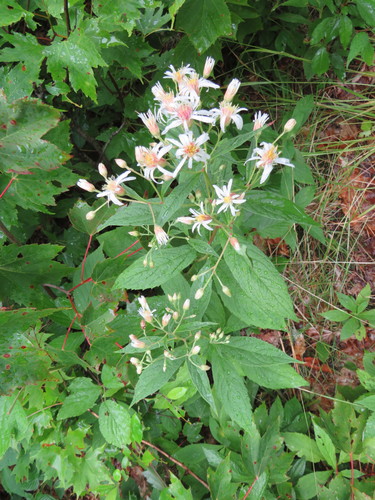
Oclemena, Genus, acuminata, Species,
- Genus & species
whorled wood aster
Overview
Oclemena acuminata, the whorled wood aster, is a herbaceous perennial in the Asteraceae growing 8-32 inches (20-80 cm) tall and 12-24 inches (30-60 cm) wide from slender, creeping rhizomes. Thin, sharply toothed leaves taper to a long, drawn-out point and are broadest above the middle, crowding toward the top of the stem so they appear loosely whorled. In late summer and autumn the stems carry a few loose flower heads, each 1-1.5 inches (2.5-4 cm) across with 6-15 narrow white rays, sometimes tinged pink or purple, around a yellow centre that ages to reddish. The plant grows in cool, moist, acidic woodland, on shaded slopes, and along forest edges, often spreading into open colonies by rhizome. It tolerates deep shade better than most asters but flowers sparsely where shade is dense and soil is dry. The zigzag stems and few large heads give it a more open, sprawling look than the dense fall asters of open ground.
Native Range
Native to northeastern North America, from eastern Canada south through New England, New York, and the Appalachian Mountains to the southern Appalachians. It grows in cool, moist, acidic woods, on shaded mountain slopes, and along forest edges and trails.Suggested Uses
Used in shade and woodland gardens, native plantings, and naturalised colonies under trees, spaced 12-18 inches (30-45 cm) apart. It suits cool, moist, shaded areas where many asters fail. The open habit and modest bloom make it less suited to formal borders or sunny, dry sites.How to Identify
Appearance
Size & Dimensions
Height8" - 2'8"
Width/Spread1' - 2'
Bloom Information
Detailed Descriptions
Flower Description
white rays with yellow disc aging reddishFoliage Description
greenGrowing Conditions
Sun Requirements
Requires 2-6 hours of direct sunlight daily
• Full Sun: 6+ hours of direct sunlight
• Partial Shade: 3-6 hours of direct sunlight
• Full Shade: Less than 3 hours of direct sunlight
Care & Maintenance
Care Guide
Grows in partial to full shade in cool, moist, acidic soil rich in leaf litter, at a pH around 4.5-6.0. Steady soil moisture supports fuller flowering, while hot, dry sites cause leaf scorch and weak bloom. It spreads slowly by rhizome to form colonies and seldom needs feeding in humus-rich woodland soil. Propagation is by division in spring or autumn or from fresh seed. Hardy in USDA zones 3-7.Pruning
Needs little pruning. Spent flowering stems are cut back in late autumn or left standing for winter structure and seed for birds. Old stems are removed at ground level in late winter before new growth begins.Pruning Schedule
Prune: March
winter