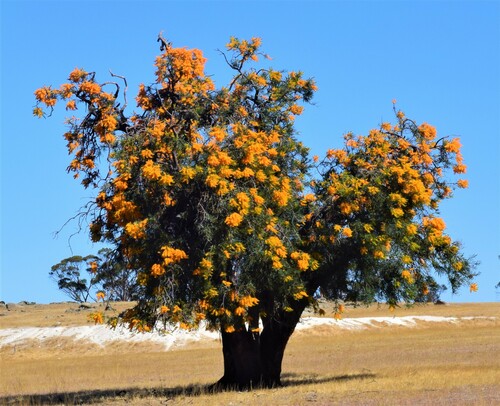
Nuytsia, Genus, spp., Multiple species,
- Genus
- Multiple species
western Australian christmas tree
Overview
Nuytsia is a genus of the showy mistletoe family (Loranthaceae) with a single species, Nuytsia floribunda, the Western Australian Christmas tree or moodjar, endemic to the south-west of Western Australia. Unusually for its family, it grows as a free-standing tree 5-10 m (16-33 ft) tall rather than a perched mistletoe, with rough grey bark and narrow, dull blue-green leaves. Despite its size it is a root hemiparasite: its roots spread widely and attach to the roots of surrounding grasses, shrubs, and trees by sucker-like haustoria, drawing water and minerals while still making its own sugars. In early to midsummer, around December and January, the whole crown turns a mass of bright orange to golden-yellow flowers in large branched sprays, giving the Christmas-tree name. Winged, three-angled fruits follow. The tree holds deep cultural meaning for the Noongar people of the region. Its haustoria can clamp onto buried cables and irrigation lines, mistaking them for roots. The species is slow to establish and hard to cultivate because of its parasitic root habit.
Native Range
Nuytsia floribunda is endemic to the south-west of Western Australia, from around Geraldton south to the coast and east toward the Esperance region. It grows in sandy soils of heath, woodland, and open forest, often in seasonally moist sites. The single species occurs nowhere else in the world.Suggested Uses
Grown mainly in native and habitat plantings and revegetation within its south-west Australian range, where host plants are present, spaced well apart. The midsummer flowers are a major nectar source for birds and insects. It has limited use as a cultivated garden tree because of its parasitic root habit.How to Identify
Appearance
Size & Dimensions
Height16' - 33'
Width/Spread10' - 20'
Bloom Information
Flowering peaks in early to midsummer, around December and January in Western Australia, when the crown fills with bright orange-gold flower sprays. The display lasts several weeks and draws many nectar-feeding birds and insects. Winged fruits develop afterwards.
Detailed Descriptions
Flower Description
Orange to golden-yellowFoliage Description
Dull blue-greenGrowing Conditions
Sun Requirements
Requires 6-12 hours of direct sunlight daily
• Full Sun: 6+ hours of direct sunlight
• Partial Shade: 3-6 hours of direct sunlight
• Full Shade: Less than 3 hours of direct sunlight
