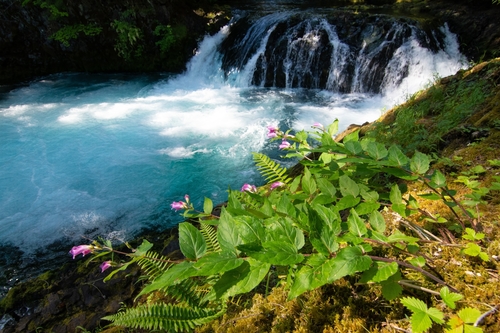
Nothochelone, Genus, nemorosa, Species,
- Genus & species
woodland beardtongue
Overview
An upright herbaceous perennial reaching 12-30 inches (30-75 cm) tall from a clump-forming crown with multiple slender stems. Leaves opposite, lance-shaped to ovate, 2-4 inches (5-10 cm) long, with serrate margins, dark green above and paler below, slightly hairy and sticky to the touch from glandular hairs. Inflorescences open panicles of 5-15 tubular flowers held at the stem tips and upper leaf axils. Each flower 1-1.5 inches (2.5-4 cm) long, two-lipped, rose-pink to pale purple with a paler throat marked by darker guidelines, the corolla swollen at the throat. Sterile staminode densely bearded with yellow hairs, characteristic of the genus and a vestige of historical placement within Penstemon. Capsules 0.3-0.5 inch (8-12 mm), ripening in late summer. Plants form clumps 12-18 inches (30-45 cm) wide after 4-6 years from seed. Stems die back to the crown by late autumn; new growth emerges from the crown in mid-spring. Lifespan 5-10 years in stable woodland sites.
Native Range
Native to moist coniferous and mixed forests of western North America from southern British Columbia south through Washington and Oregon to northern California. Found in shaded forest understory, streambanks, and open coniferous woodlands at 500 to 6,000 feet (150-1,830 m) elevation.Suggested Uses
Commonly planted in shaded native plant gardens, woodland edges, and rain gardens at 12-18 inch (30-45 cm) spacing. Suitable for containers of at least 3 gallons (11 L) with consistent moisture and partial shade. Pairs in cultivation with other moist-shade natives such as Tellima grandiflora, Tiarella trifoliata, and ferns.How to Identify
Appearance
Size & Dimensions
Height1' - 2'6"
Width/Spread1' - 1'6"
Bloom Information
June through August; lowland populations bloom in June-July, montane populations into August. Each panicle holds open flowers for 3-4 weeks; the full bloom period in a stand extends 5-7 weeks.
Detailed Descriptions
Flower Description
rose-pink to pale purpleFoliage Description
dark greenGrowing Conditions
Sun Requirements
Requires 2-6 hours of direct sunlight daily
• Full Sun: 6+ hours of direct sunlight
• Partial Shade: 3-6 hours of direct sunlight
• Full Shade: Less than 3 hours of direct sunlight
Care & Maintenance
Care Guide
Plant container-grown specimens in autumn or early spring into well-drained loamy soil with high organic matter and partial shade. Water weekly during the first growing season; established plants tolerate periods of 2-3 weeks without rain in shaded sites. Powdery mildew develops on stressed plants in dry summer conditions; consistent moisture reduces incidence. Slugs feed on emerging shoots in mild wet springs. Plants are short-lived in heavy clay soils and may decline within 3-4 years; lifespan in well-drained loam extends to 8-10 years. Self-sown seedlings replace mature plants in established stands.Pruning
Cut spent flower stems to 4-6 inches (10-15 cm) above the soil after seed has dispersed in late summer. Cut the entire plant to ground level in late autumn or early spring; new growth emerges from the crown in mid-spring. Damaged or yellowing foliage can be removed at the base at any time during the growing season.Pruning Schedule
Prune: March & September–October
fallearly spring
Container Growing
Suitable for container growing
Minimum container size: 3 gallons