Noccaea, Genus, fendleri, Species,
- Genus & species
Fendler's pennycress
Overview
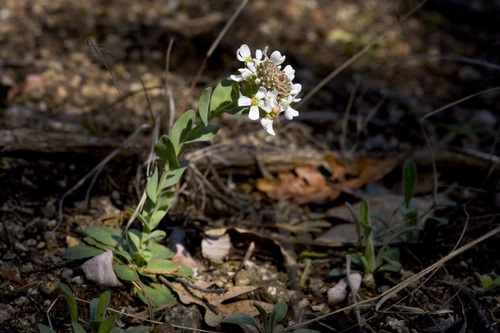
Noccaea fendleri is a low perennial herb of western North American mountains, forming basal rosettes of spoon-shaped gray-green leaves and sending up flowering stems 4-12 inches (10-30 cm) tall. The stem leaves are smaller and clasp the stem with ear-like lobes. From early spring it bears rounded clusters of small four-petaled flowers, each 0.2-0.3 inch (5-8 mm) across, in white to pale pink or lavender. As the flowers fade, flattened heart-shaped seed pods 0.2-0.4 inch (5-10 mm) long develop along the lengthening stem, each notched at the tip in the manner typical of the mustard family. The plant grows from a slender taproot and woody base, returning each year and often forming small colonies. N. fendleri occupies rocky slopes, gravelly meadows, and open conifer woodland from foothills to alpine ridges, generally between 5,000 and 12,000 feet (1,500-3,650 m). It tolerates cold, wind, and thin soils but is short-lived and may persist only a few years in cultivation. Its small size and early dormancy after seeding limit its presence in the garden to the spring months.
Native Range
Noccaea fendleri is native to western North America, ranging through the Rocky Mountains and intermountain ranges from Canada south into Mexico, and west to the Sierra Nevada. It grows on rocky slopes, gravelly meadows, and open montane to alpine ground.Suggested Uses
N. fendleri is used in alpine and rock gardens, troughs, and gravelly native plantings of cold mountain regions, where it produces early spring flowers among stone. It suits crevice gardens and scree beds that drain sharply. Its short life and summer dormancy make it a seasonal rather than year-round feature.How to Identify
Appearance
Size & Dimensions
Height4" - 1'
Width/Spread4" - 8"
Bloom Information
Flowering begins soon after snowmelt, from spring into early summer and later at higher elevations, roughly April through July depending on altitude. The clustered white to pink flowers open over two to three weeks and draw early bees and flies. Flat seed pods follow quickly, and the plant often goes dormant by midsummer once seed is shed.
Detailed Descriptions
Flower Description
White to pale pinkFoliage Description
Gray-greenGrowing Conditions
Sun Requirements
Requires 6-10 hours of direct sunlight daily
• Full Sun: 6+ hours of direct sunlight
• Partial Shade: 3-6 hours of direct sunlight
• Full Shade: Less than 3 hours of direct sunlight
Care & Maintenance
Care Guide
N. fendleri grows in full sun to partial shade in gritty, sharply drained soil with a neutral to alkaline pH of 6.5-8.0. It suits cold-climate rock gardens and troughs that get winter chill and dry summer drainage. Plants need moisture in spring during growth and flowering, then drier conditions as they go dormant. Rich soil and standing moisture cause root rot and shorten an already brief life. It self-sows where conditions suit, which replaces short-lived parent plants. Pests are minor, though aphids and flea beetles, common to the mustard family, may appear.Pruning
N. fendleri needs no pruning beyond removing spent flowering stems after the pods shed seed. Leaving some stems in place lets the plant self-sow to renew the colony. The basal rosettes are left undisturbed through dormancy.Container Growing
Suitable for container growing
Minimum container size: 1 gallons