Neottia, Genus, spp., Multiple species,
- Genus
- Multiple species
twayblade
Temperate and montane Northern Hemisphere
Overview
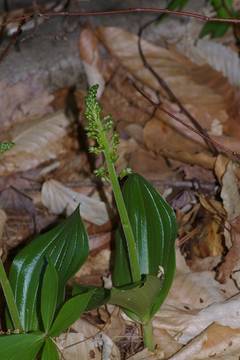
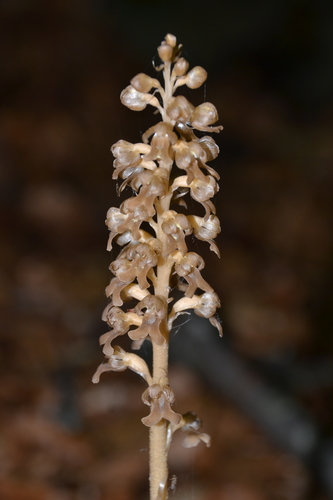
Neottia is a genus of terrestrial orchids in the family Orchidaceae, spread across temperate and montane parts of the Northern Hemisphere, now including the twayblades once placed in Listera. The genus holds two contrasting groups. Most species, the twayblades, are green plants 10-60 cm (4-24 in) tall bearing a single opposite pair of broad to heart-shaped leaves partway up the stem and a slender spike of small green to yellow-green flowers, each with a deeply forked lip. The other group, typified by N. nidus-avis, the bird's-nest orchid, lacks chlorophyll entirely: these honey-brown plants draw all their carbon from soil fungi linked to tree roots and carry no true leaves, only brownish scales. Flowers across the genus are small and sit above a dense tangle of short roots, the feature behind the bird's-nest name. Plants grow in shaded woodland and damp grassland in leaf-rich soil. All depend heavily on specific soil fungi, so Neottia is rarely transplanted or cultivated and persists where left undisturbed in the wild.
Native Range
Neottia occurs across the temperate and montane Northern Hemisphere, through Europe, North Africa, much of Asia, and North America. The twayblade species range widely in woodland and grassland, while N. nidus-avis follows shaded broadleaf and conifer woodland on humus-rich, often calcareous soil. Several species reach high latitudes and mountain elevations.Suggested Uses
Neottia is a plant of natural and naturalistic woodland rather than cultivated borders, kept where it occurs as part of native ground flora. In woodland gardens it is conserved in situ alongside other shade plants rather than introduced. It has no role as a transplant or container subject.How to Identify
Appearance
Size & Dimensions
Height4" - 2'
Width/Spread4" - 8"
Bloom Information
Detailed Descriptions
Flower Description
Green to honey-brownFoliage Description
Green, leafless and brown in some speciesGrowing Conditions
Sun Requirements
Tolerates up to 3 hours of direct sunlight daily
• Full Sun: 6+ hours of direct sunlight
• Partial Shade: 3-6 hours of direct sunlight
• Full Shade: Less than 3 hours of direct sunlight