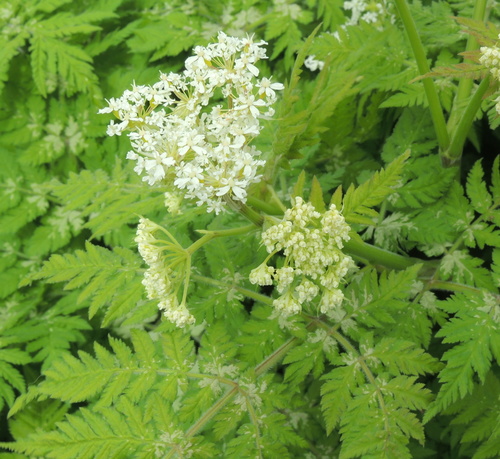
Myrrhis, Genus, spp., Multiple species,
- Genus
- Multiple species
sweet cicely
Mountains of central and southern Europe
Overview
Myrrhis is a genus in the carrot family (Apiaceae) represented chiefly by Myrrhis odorata, a clump-forming herbaceous perennial of central and southern European mountain meadows and woodland edges. Plants reach 60-180 cm (24-71 in) tall and 60-100 cm (24-39 in) wide, building a basal mound of soft, fern-like leaves. The foliage is two- to three-pinnate, divided into many toothed segments, mid-green and often flecked with pale markings, and carries a sweet anise scent when bruised. Hollow ridged stems rise above the leaves in late spring, topped by flat compound umbels 2-5 cm (0.8-2 in) across holding many small white flowers. These are followed by narrow ridged fruits 15-25 mm (0.6-1 in) long that ripen from green to glossy dark brown. Leaves, stems, and unripe seeds carry an aniseed flavour and are used as a culinary herb across the native range. Plants die back to a deep taproot each winter and re-emerge early the following spring. The taproot makes established clumps slow to relocate, and self-sown seedlings can spread into nearby borders where conditions stay cool and moist.
Native Range
Myrrhis is native to the mountains of central and southern Europe, from the Pyrenees and Alps east through the Balkans, growing in damp meadows, pastures, and open woodland at roughly 200-2,000 m (650-6,550 ft). It has naturalised in cooler temperate regions beyond this range, including parts of northern Europe and North America.Suggested Uses
Grown in herb gardens, cottage borders, and the dappled edges of woodland plantings, spaced 45-60 cm (18-24 in) apart. The aniseed-flavoured leaves and seeds are used in the kitchen, and the early umbels draw pollinating insects.How to Identify
Appearance
Size & Dimensions
Height2' - 5'11"
Width/Spread2' - 3'3"
Bloom Information
Detailed Descriptions
Foliage Description
Mid-green, sometimes flecked whiteGrowing Conditions
Sun Requirements
Requires 3-6 hours of direct sunlight daily
• Full Sun: 6+ hours of direct sunlight
• Partial Shade: 3-6 hours of direct sunlight
• Full Shade: Less than 3 hours of direct sunlight
