Monoptilon, Genus, bellioides, Species,
- Genus & species
Mojave desertstar
Southwestern United States and northwestern Mexico
Overview
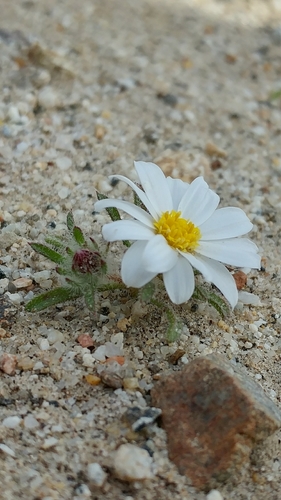
Monoptilon bellioides is a low, spreading winter annual of the Mojave and Sonoran deserts, forming flat rosettes and cushions usually 1-4 inches (2.5-10 cm) tall and up to 8 inches (20 cm) across. The stems are slender, branching from the base and pressed close to the ground, covered in stiff white hairs. Small narrow leaves 0.2-0.5 inch (5-12 mm) long crowd the stems. Each branch tip bears a single daisy-like flower head about 0.5-1 inch (12-25 mm) wide, with 12-25 white to pale lavender ray florets surrounding a yellow disk. After wet winters the plant can carpet open desert pavement and sandy flats with bloom, while in dry years it may germinate sparsely or not at all. M. bellioides completes its life cycle in a single season, setting seed and dying as the soil dries in late spring. It grows in gravelly and sandy desert soils in full sun and depends entirely on seasonal rainfall, so it cannot persist where summer water collects. Its small size means it is quickly overtopped by taller vegetation, limiting it to open, sparsely vegetated ground.
Native Range
Monoptilon bellioides is native to the deserts of the southwestern United States and northwestern Mexico, including the Mojave and Sonoran deserts of California, Nevada, Arizona, Utah, and Baja California. It grows on open desert pavement, gravelly flats, and sandy washes below about 3,500 feet (1,070 m).Suggested Uses
M. bellioides is used in desert and rock gardens, gravel plantings, and restoration seeding of arid sites where it fills bare ground with low spring bloom. It suits naturalistic xeriscapes that receive winter rain and dry out in summer. Its tiny stature makes it suitable for the front of gravel beds rather than mixed borders.How to Identify
Appearance
Size & Dimensions
Height1" - 4"
Width/Spread6" - 8"
Bloom Information
Flowering follows winter and early-spring rains, typically February through May, with the exact timing and abundance set by rainfall. In wet years the heads open across the whole plant at once; in dry years few or none appear. Bees and small desert insects visit the flowers, which close as the soil dries and quickly set seed.
Detailed Descriptions
Flower Description
White with yellow centerFoliage Description
GreenGrowing Conditions
Sun Requirements
Requires 6-12 hours of direct sunlight daily
• Full Sun: 6+ hours of direct sunlight
• Partial Shade: 3-6 hours of direct sunlight
• Full Shade: Less than 3 hours of direct sunlight
Water & Climate
Water Needs
Drought Tolerance
Drought tolerant when established
Care & Maintenance
Care Guide
M. bellioides grows in full sun on gravelly or sandy, sharply drained desert soil with a neutral to alkaline pH of 7.0-8.5. As a desert annual it needs winter moisture to germinate and a dry, warm spring to flower and set seed. Sowing seed in autumn onto bare mineral soil mimics its natural cycle, and no fertilizer is required. Excess water or rich soil causes weak growth and rot. The plant dies after seeding, returning only from seed the following season. It has no major pests in its dry open habitat.Pruning
M. bellioides needs no pruning. As a small annual it is left in place to flower and set seed, after which the dried plant can be cleared. Leaving spent plants allows seed to drop for the next season germination.Container Growing
Suitable for container growing
Minimum container size: 1 gallons
Toxicity
Non-toxicPlanting Guide
Planting Methods & Timing
Planting Method
direct sow
Direct Sow Timing
Autumn
Days to Maturity
60–90 days
Plant Spacing
6 inches