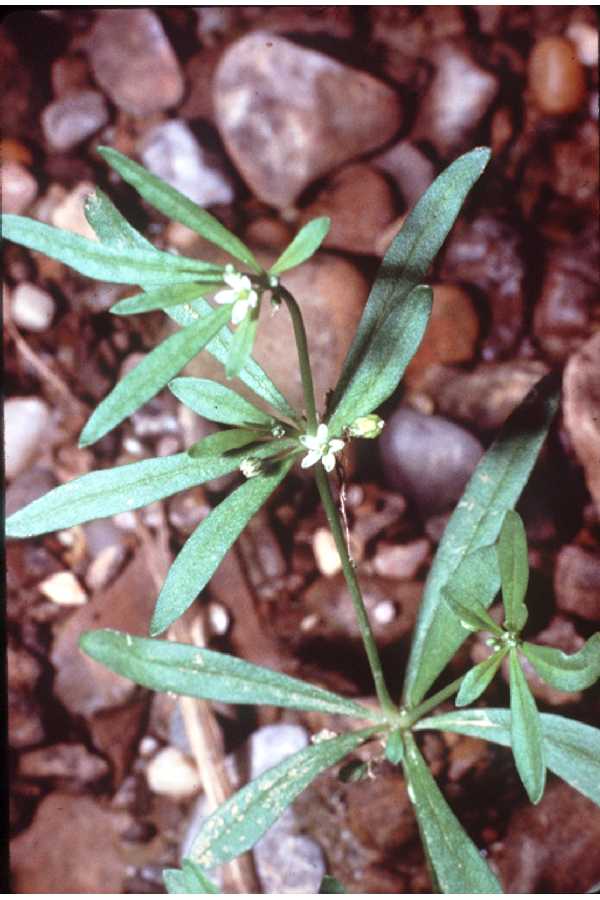
Mollugo, Genus, verticillata, Species,
- Genus & species
green carpetweed
Tropical and warm-temperate Americas (now widespread)
SunFull Sun
Overview
Mollugo verticillata is a low, mat-forming summer annual in the family Molluginaceae, spreading flat across the ground in a circular patch 4-16 inches (10-40 cm) wide. The smooth, branching stems radiate from a central taproot and lie close to the soil. Narrow, spoon-shaped leaves 0.2-1.2 inches (5-30 mm) long are arranged in whorls of three to eight at each node, giving the plant a wheel-spoke look. Small white flowers about 0.1 inch (2-3 mm) across rise on thin stalks from the leaf whorls through summer and into fall. Each flower forms a tiny three-parted capsule with many small seeds. It germinates in late spring once the soil warms, grows quickly in hot weather, and dies with frost. It colonizes bare, disturbed ground such as gardens, fields, paths, sandy banks, and crop rows, tolerating poor and compacted soil. One limitation is its weediness: a single plant produces thousands of seeds and forms dense mats over open soil in a single season.
Native Range
Mollugo verticillata is considered native to the warmer parts of the Americas and has spread as a weed across temperate and tropical regions worldwide. In North America it is widespread in disturbed and cultivated ground across most of the United States and southern Canada.Suggested Uses
Mollugo verticillata is not grown ornamentally and is managed as a warm-season weed in gardens, lawns, and crops. It has historically been gathered as an edible cooked green in some regions. In plantings it appears only as an uninvited colonizer of bare soil.How to Identify
Appearance
Size & Dimensions
Height1" - 2"
Width/Spread4" - 1'4"
Bloom Information
Detailed Descriptions
Foliage Description
greenGrowing Conditions
Sun Requirements
Requires 6-12 hours of direct sunlight daily
• Full Sun: 6+ hours of direct sunlight
• Partial Shade: 3-6 hours of direct sunlight
• Full Shade: Less than 3 hours of direct sunlight
Water & Climate
Water Needs
Drought Tolerance
Drought tolerant when established