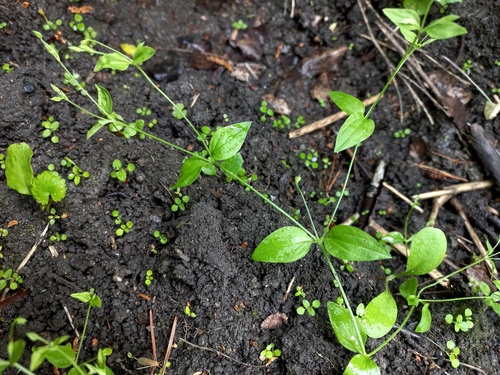
Moehringia, Genus, trinervia, Species,
- Genus & species
three-nerved sandwort
Europe, western Asia, and North Africa
SunPart Shade – Full Shade
WaterMedium
Overview
Moehringia trinervia is a slender annual of the pink family, growing 5-16 inches (12-40 cm) tall with a sprawling, much-branched habit. The stems are weak and brittle, often propped up by surrounding vegetation. Leaves are opposite, ovate to elliptical, 0.2-0.7 inch (5-18 mm) long, and marked by three, sometimes five, raised veins that give the plant its common name. Each leaf tapers to a short point and carries short hairs along the margins. Flowers appear singly or in loose clusters from the upper leaf axils, measuring about 0.2 inch (6 mm) across, with five white petals shorter than the five green, pointed sepals. The seed capsules open by six teeth to release small, kidney-shaped seeds bearing a pale appendage that draws ants for dispersal. As a winter or spring annual, the whole plant completes its cycle within a single season and dies back after seeding. It grows in shaded and semi-shaded ground, where its trailing stems are hard to pick out among leaf litter. The species has little structural presence in cultivation and self-seeds readily, which can make it persistent once established. Growth is fastest in cool, damp conditions and slows once soils warm and dry in midsummer.
Native Range
Native to Europe, western Asia, and North Africa, where it grows in deciduous woodland, hedge banks, and shaded disturbed ground.Suggested Uses
Found in woodland gardens and shaded naturalistic plantings, usually as a self-sown groundcover among taller perennials. Its low, trailing stems knit through leaf litter but add no lasting display. Density is seldom managed by hand, as the plant regulates its own spacing through seeding.How to Identify
Appearance
Size & Dimensions
Height5" - 1'4"
Width/Spread6" - 1'
Bloom Information
Flowering runs from May to June, occasionally into July at cooler or higher sites. The small white flowers open in the upper leaf axils and give way within a few weeks to six-toothed capsules. The flowers are self-compatible and receive visits from small flies and beetles.
Detailed Descriptions
Foliage Description
greenGrowing Conditions
Sun Requirements
Tolerates up to 4 hours of direct sunlight daily
• Full Sun: 6+ hours of direct sunlight
• Partial Shade: 3-6 hours of direct sunlight
• Full Shade: Less than 3 hours of direct sunlight
Water & Climate
Water Needs
Care & Maintenance
Care Guide
This annual grows in moist, humus-rich soils in partial to full shade, mirroring its woodland origins. It tolerates a range of soil types where drainage is steady and the surface stays cool and damp. No winter protection is needed, and the plant relies on self-seeding to reappear each year. Seedlings establish quickly from seed left on the soil surface in autumn or early spring, as light aids germination. Rich, heavily fed conditions encourage lank, floppy stems and reduce flowering. In gardens it turns up most often as a spontaneous colonist of shaded beds rather than a deliberately grown plant.Pruning
No pruning is required for this annual. Spent plants can be cleared once they have set seed, though leaving them in place allows natural self-seeding. Clearing plants before the capsules ripen limits unwanted spread.Toxicity
Non-toxicPlanting Guide
Planting Methods & Timing
Planting Method
direct sow
Direct Sow Timing
Autumn or early spring
Plant Spacing
6 inches