Mitrasacme, Genus, polymorpha, Species,
- Genus & species
mitre weed
Overview
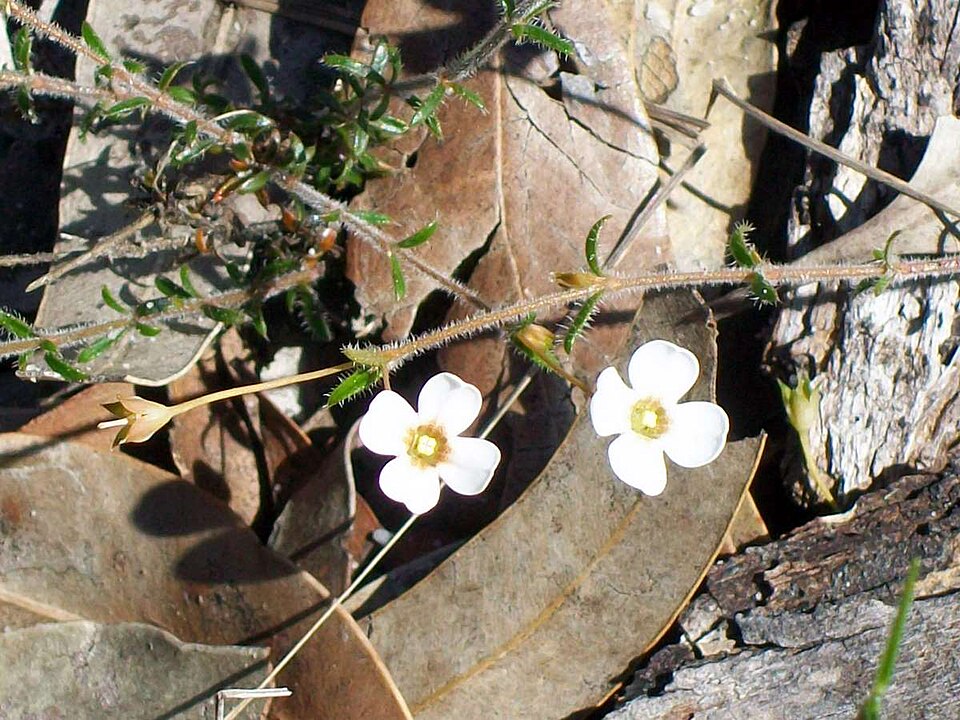
Mitrasacme polymorpha is a slender, variable herb growing 2-12 inches (5-30 cm) tall, ranging from annual to short-lived perennial depending on conditions. Stems are thin, erect to spreading, and often wiry, branching from the base. Leaves are small, 0.1-0.4 inch (3-10 mm) long, narrow to oval, and arranged in opposite pairs or whorls along the lower stem, sometimes crowded into a basal cluster. Small white tubular flowers, about 0.1-0.2 inch (3-5 mm) long with four spreading lobes, are carried singly on thread-like stalks at the stem tips. Flowering occurs mainly in spring and summer. The fruit is a small two-parted capsule topped by two diverging beaks, the feature behind the common name mitre weed. As the species epithet suggests, leaf size, stem height, and growth form vary widely between populations and habitats. Plants grow in seasonally moist ground and may complete their life cycle quickly where soil dries out.
Native Range
Native to eastern and south-eastern Australia, including Queensland, New South Wales, Victoria, Tasmania, and South Australia, with related populations in New Caledonia and parts of South-East Asia. Grows in heath, sedgeland, open forest, and swamp margins in damp sandy or peaty soils.Suggested Uses
Grown occasionally in native plant and bog-garden collections in damp, low-nutrient soil. Suited to seasonally wet sand or peat beds rather than general garden borders. Has no role in conventional ornamental planting.How to Identify
Appearance
Size & Dimensions
Height2" - 1'
Width/Spread2" - 6"
Bloom Information
Flowers mainly from September to February, with timing shifting by region and rainfall. Individual flowers are short-lived, but a plant produces flowers over several weeks. In drier sites flowering is compressed into a short period after rain.
Detailed Descriptions
Foliage Description
greenGrowing Conditions
Sun Requirements
Requires 4-8 hours of direct sunlight daily
• Full Sun: 6+ hours of direct sunlight
• Partial Shade: 3-6 hours of direct sunlight
• Full Shade: Less than 3 hours of direct sunlight
Care & Maintenance
Care Guide
Grows in damp, low-nutrient sandy or peaty soils in open sunny to lightly shaded sites. Soil that stays seasonally moist supports longer growth, while rapid drying shortens the life cycle to a single season. The species is seldom cultivated and has no commercial nursery trade. Where grown in native plant collections, it needs an open, low-fertility medium and steady moisture during the growing season. Excess fertilizer and dense competition from larger plants reduce its persistence.Pruning
No pruning is required. Spent stems can be cut back after flowering and fruiting. Plants may self-seed where soil is left undisturbed.Container Growing
Suitable for container growing
Minimum container size: 1 gallons