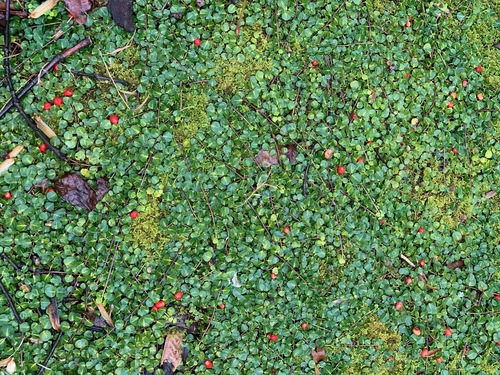
Mitchella, Genus, spp., Multiple species,
- Genus
- Multiple species
partridgeberry
Eastern North America and eastern Asia
Overview
Mitchella is a small genus of evergreen, creeping subshrubs in the madder family (Rubiaceae), with two species: M. repens, partridgeberry of eastern North America, and M. undulata of eastern Asia. Plants form low, trailing mats only 1-2 inches (2.5-5 cm) tall, with slender stems that root at the nodes and spread to about 12 inches (30 cm) or more across. The small, rounded, opposite leaves are glossy dark green, often marked with a pale midrib, and remain through winter. In late spring and summer the stems carry flowers in fused pairs: each pair of white, sometimes pink-tinged, trumpet-shaped flowers shares a single ovary, and the two flowers together ripen into one scarlet berry. The berries are edible but nearly tasteless and persist into winter, feeding birds and small mammals. The flowers are fragrant and four-lobed, with a hairy inner surface. The genus grows on acidic, humus-rich, moist but well-drained woodland soils in partial to full shade and slowly knits into an evergreen ground cover.
Native Range
Mitchella repens is native to woodlands across eastern and central North America, while M. undulata occurs in moist forests of Japan, Korea, and China. Both grow as ground cover on the floor of shaded, acidic woodland.Suggested Uses
Grown as an evergreen ground cover in shade and woodland gardens, along shaded path edges, and in containers and terrariums on acidic mix. The persistent red berries and glossy foliage carry interest into winter. The genus suits native-plant and naturalistic shade plantings under trees and shrubs.How to Identify
Appearance
Size & Dimensions
Height1" - 2"
Width/Spread1' - 1'6"
Bloom Information
Flowering occurs in late spring and early summer, generally May to July. The fragrant white, four-lobed flowers open in fused pairs at the stem tips and are pollinated by bees. A single red berry develops from each flower pair and persists into the following winter.
Detailed Descriptions
Flower Description
White, sometimes pink-tingedFoliage Description
Dark green with pale midribGrowing Conditions
Sun Requirements
Requires 1-5 hours of direct sunlight daily
• Full Sun: 6+ hours of direct sunlight
• Partial Shade: 3-6 hours of direct sunlight
• Full Shade: Less than 3 hours of direct sunlight
Care & Maintenance
Care Guide
Plants grow in partial to full shade on cool, moist, acidic, humus-rich soils with free drainage, matching the woodland floor of the genus. Steady moisture and a mulch of leaf litter suit the shallow, rooting stems, while dry, exposed, or limy sites cause decline. Growth and spread are slow, so a planting takes time to knit together. Established mats need little care beyond keeping fallen leaves from smothering them. Propagation is by rooted stem pieces, division, or seed, though seed is slow to germinate. The genus dislikes root disturbance once settled.Pruning
Little or no pruning is needed. Overlapping or stray stems can be trimmed to shape the mat, and fallen tree leaves are cleared in autumn so they do not bury the low foliage. Rooted pieces lifted in spring start new plants.Pruning Schedule
Prune: October
fall
Container Growing
Suitable for container growing
Minimum container size: 1 gallons
