Mikania, Genus, spp., Multiple species,
- Genus
- Multiple species
hempvines
Tropical and subtropical America, with fewer species in Africa and Asia
Overview
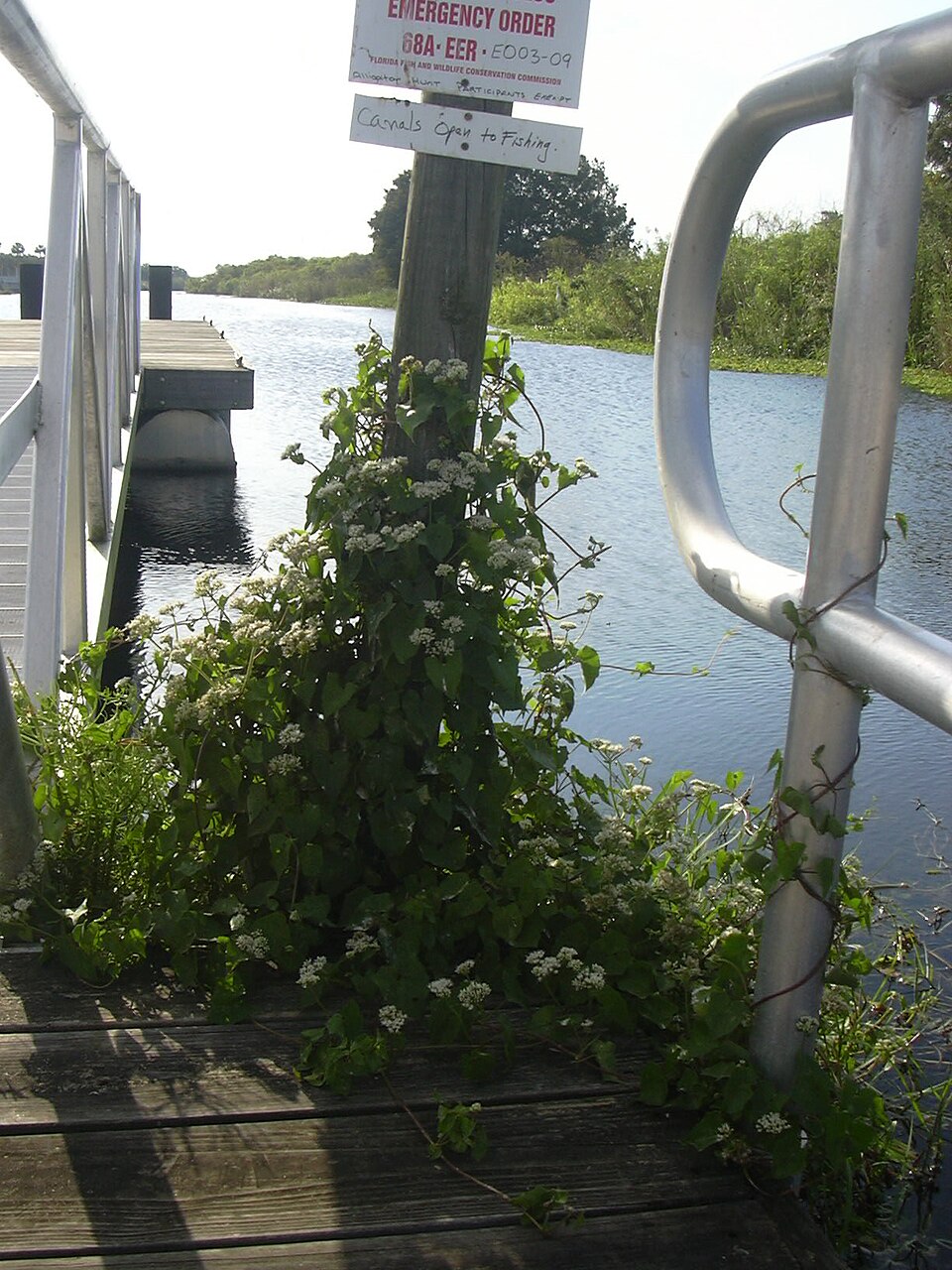
Mikania is a genus of roughly 400-450 species in the daisy family (Asteraceae), most of them twining or climbing herbaceous to woody perennial vines. Stems twine and extend 3-20 ft (1-6 m) per season depending on species and climate. Leaves are opposite, simple, and often heart-shaped to triangular, 1-5 in (2.5-13 cm) long, with palmate venation and toothed or entire margins. The flower heads are small, 0.2-0.3 in (5-8 mm), each containing four tubular florets without ray florets, grouped into branched corymb-like clusters. Florets range from white and cream to pale pink or greenish. Flowering is followed by small dry one-seeded fruits tipped with a pappus of bristles that carries them on wind. The genus is concentrated in tropical and subtropical America, with fewer species in Africa and Asia. Several species climb over shrubs and small trees, where dense growth shades host foliage; M. micrantha spreads quickly in disturbed humid sites and is regulated as a noxious weed in parts of Asia and the Pacific. Most species occupy forest margins, riverbanks, and clearings. Foliage and stems contain pyrrolizidine alkaloids, which are toxic to grazing livestock and to humans if ingested.
Native Range
The genus is centred in tropical and subtropical America, from the southeastern United States through Mexico, Central America, and South America, with the greatest concentration in Brazil. A smaller number of species occur in sub-Saharan Africa, Madagascar, and tropical Asia.Suggested Uses
Grown occasionally as a quick cover for fences, arbors, and screens in frost-free and subtropical gardens. In native plantings, M. scandens grows along pond margins and damp thickets where its twining stems climb supporting vegetation.How to Identify
Appearance
Size & Dimensions
Height3' - 20'
Width/Spread3' - 10'
Bloom Information
Flowering across the genus occurs mainly in late summer through autumn, though tropical species can bloom through much of the year where temperatures stay warm. Individual clusters open over several weeks, releasing wind-dispersed seed shortly after. In M. scandens of eastern North America, bloom runs roughly August-October.
Detailed Descriptions
Flower Description
white to cream, pale pink, or greenishFoliage Description
greenGrowing Conditions
Sun Requirements
Requires 4-8 hours of direct sunlight daily
• Full Sun: 6+ hours of direct sunlight
• Partial Shade: 3-6 hours of direct sunlight
• Full Shade: Less than 3 hours of direct sunlight
Water & Climate
Water Needs
Care & Maintenance
Care Guide
Most species grow in full sun to part shade and in moist, fertile soils, though several tolerate periodic flooding along watercourses. Growth is quickest in warm, humid conditions with steady moisture; cooler or drier sites slow extension and reduce flowering. Soils ranging from loam to clay are accepted provided drainage is not stagnant for long periods. In cultivation the twining stems climb a trellis or host structure, and unsupported plants form low tangled mats. Spread can be vigorous, and stems root where nodes contact moist soil, so growth often needs containment. Foliage contains pyrrolizidine alkaloids, making the plants unsuitable for areas grazed by livestock.Pruning
Stems can be cut back hard in late winter or early spring to limit extent, since flowering occurs on current-season growth. Detached stem fragments root readily where nodes meet moist ground, so cut material left on site can re-establish.Pruning Schedule
Prune: February–March
winterearly spring
