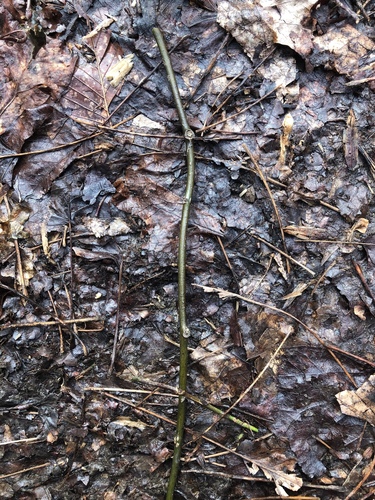
Menispermum, Genus, canadense, Species,
- Genus & species
moonseed
Overview
Menispermum canadense is a deciduous woody vine that twines to 12-20 feet (3.7-6 m), climbing shrubs, fences, and trees by wrapping its slender stems rather than by tendrils. The alternate leaves are 4-8 inches (10-20 cm) wide, broadly heart-shaped to shallowly 3-7 lobed, with the leaf stalk attached just inside the margin, bright green above and paler beneath. Small greenish-white flowers open in loose hanging clusters in early summer, with male and female flowers on separate plants. Pollinated female flowers ripen into clusters of round blue-black drupes 0.3 inch (8 mm) wide with a whitish bloom, closely resembling wild grapes. Each drupe holds a single flattened, crescent-shaped seed, the source of the common name. The fruit is poisonous, containing the alkaloid dauricine, and has caused serious and fatal poisonings when mistaken for grapes. The vine spreads by seed and creeping rhizomes along streams, fencerows, and moist woods across eastern North America. One trade-off is the toxic grape-like fruit, which poses a risk where children or foragers may confuse it with wild grape.
Native Range
Native to eastern North America, from Quebec and Manitoba south to Georgia and Oklahoma. It grows in moist woods, thickets, ravines, fencerows, and along streams and pond edges on rich soils.Suggested Uses
Used on trellises, fences, and arbors in native and woodland plantings and for quick screening in moist shade. It is grown for fruit and cover for birds, on sites set apart from areas used by children, given the toxic berries.How to Identify
Appearance
Size & Dimensions
Height12' - 20'
Width/Spread3' - 6'
Bloom Information
Loose hanging clusters of small greenish-white flowers open in June and July. Male and female flowers grow on separate plants, so only female vines set fruit. Blue-black drupes follow and ripen by early fall.
Detailed Descriptions
Foliage Description
Bright green above, paler beneathGrowing Conditions
Sun Requirements
Requires 4-8 hours of direct sunlight daily
• Full Sun: 6+ hours of direct sunlight
• Partial Shade: 3-6 hours of direct sunlight
• Full Shade: Less than 3 hours of direct sunlight
Care & Maintenance
Care Guide
Grows in part shade to full sun in moist, fertile, well-drained soils at pH 5.5-7.5, and tolerates clay and short wet spells. It climbs by twining and needs a support of shrubs, a fence, or a trellis, spreading also by underground rhizomes to form patches. Hardy in zones 4-8, it dies back at the stem tips in cold winters and resprouts from the base. All parts, especially the ripe fruit, contain toxic alkaloids and are poisonous if eaten. It needs little care once established and can overrun nearby plants if rhizomes are left to run.Pruning
Stems are cut back in late winter to control size and shape on a support. Rhizome shoots are dug out at the edges to keep the vine from spreading into beds. Fruiting female vines can be cut before berries ripen where the toxic fruit is a concern.Pruning Schedule
Prune: February
winter