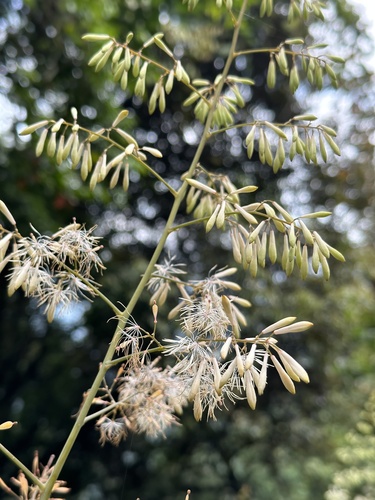
Macleaya, Genus, cordata, Species,
- Genus & species
plume poppy
Overview
Macleaya cordata is a tall rhizomatous perennial in the family Papaveraceae, native to central and eastern China and Japan. Plants spread laterally by underground rhizomes to form large colonies of sturdy glaucous stems 6-10 feet (180-300 cm) tall, carrying deeply lobed heart-shaped leaves 6-10 inches (15-25 cm) across with a blue-green upper surface and silvery-white downy undersides. The silvery reverse flashes conspicuously when leaves move in the breeze. In summer, the stems are topped with feathery panicles 12-18 inches (30-45 cm) long of hundreds of tiny petal-less flowers whose cream to buff-pink color comes from the stamens rather than petals; the overall flowering effect reads as a smoke-like or foam-like mass at height. Cut stems and foliage exude an orange-yellow latex sap that causes skin irritation in some people. Rhizome spread is aggressive: established colonies extend 3-6 feet (90-180 cm) or more per year in fertile moist soil. Growth rate is fast, reaching full size in 1-2 years. Hardy to USDA zone 3. Spread behavior limits the species to large plantings or sites with buried rhizome barriers; small gardens and formal plantings are unsuitable. All parts contain alkaloids and are toxic if ingested.
Native Range
Macleaya cordata is native to central and eastern China and Japan, in open scrub, forest margins, hillsides, and disturbed ground. Naturalized in parts of Europe and North America in similar open habitats.Suggested Uses
Planted as a back-of-border architectural presence, informal summer screen, or large-scale naturalistic anchor at 4-6 foot (120-180 cm) spacing. The massive leaves and 6-10 foot stems create height in prairie-style and wild plantings alongside Miscanthus, Eutrochium, and large Rudbeckia. Small formal plantings, tight mixed borders, and sites adjacent to smaller perennials fall outside the use range because rhizome spread overwhelms smaller neighbors.How to Identify
Appearance
Size & Dimensions
Height6' - 10'
Width/Spread3' - 6'
Bloom Information
Feathery panicles 12-18 inches (30-45 cm) long of tiny petal-less cream to buff-pink flowers, borne July through August in zones 3-8. Panicles persist several weeks and transition in color from cream through buff-pink to tan as flowers age and seed develops. Bold foliage carries ornamental effect from spring emergence through fall frost. In the Pacific Northwest, reliable bloom occurs in July.
Detailed Descriptions
Flower Description
Cream to buff-pink aging to tan; tiny petal-less flowers (color from stamens); feathery panicles 12-18 inches (30-45 cm); July-AugustFoliage Description
Blue-green upper surface with silvery-white downy underside; deeply lobed heart-shaped 6-10 inches (15-25 cm); deciduous; orange-yellow latex when cutGrowing Conditions
Sun Requirements
Requires 4-8 hours of direct sunlight daily
• Full Sun: 6+ hours of direct sunlight
• Partial Shade: 3-6 hours of direct sunlight
• Full Shade: Less than 3 hours of direct sunlight
Care & Maintenance
Care Guide
Grows in full sun to partial shade in any reasonably fertile moist but well-drained soil at pH 5.5-7.5. Hardy to USDA zone 3. A wide range of soil conditions is tolerated, including lean and clay soils and moderate drought once plants are established. Spread management requires a buried rhizome barrier 12-18 inches (30-45 cm) deep around the planting area, or annual spade-cutting of runners in spring. The species is unsuited to plantings adjacent to smaller perennials, which are overrun within 2-3 seasons. The orange latex sap can irritate sensitive skin, and all parts are toxic if ingested.Pruning
Stems are cut to ground level in late fall or early spring. In late spring, rhizome runners that have crossed the intended bed edge are severed with a sharp spade before new stems mature. Division in spring is used both for propagation and for active containment; severed rhizome sections replant successfully if lifted with at least one growing bud.Pruning Schedule
Prune: March–April & October
early springfall