Maackia, Genus, amurensis, Species,
- Genus & species
Amur maackia
Northeastern Asia (Manchuria, Russian Far East, Korea, Hokkaido)
Overview
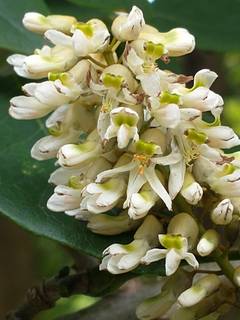
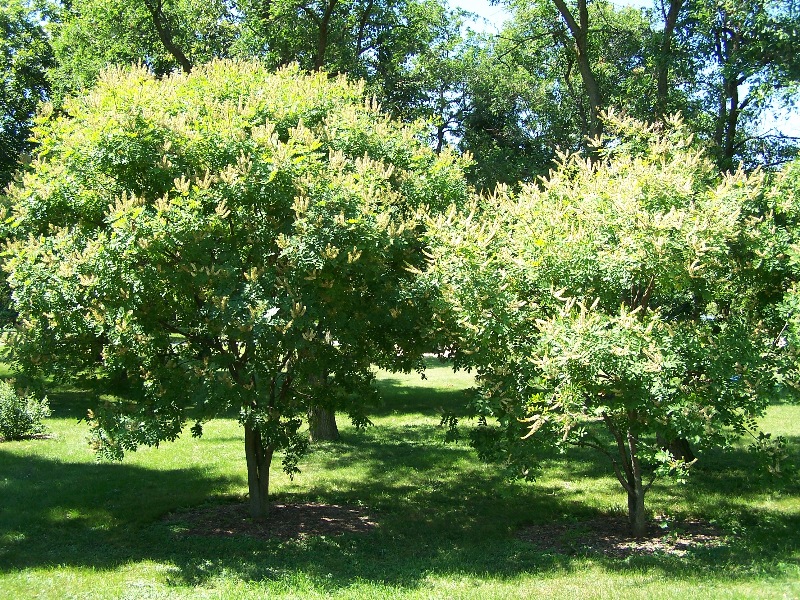
Maackia amurensis is a small to medium deciduous tree reaching 20–35 feet (6–10.5 m) tall and 20–30 feet (6–9 m) wide with a rounded to vase-shaped crown. The species is in the legume family and fixes atmospheric nitrogen in root nodules, tolerating poor soils and reducing supplemental fertilizer needs. Leaves are alternate and pinnately compound, 8–12 inches (20–30 cm) long, with 7–11 ovate leaflets, each 1.5–3 inches (4–8 cm) long. New foliage emerges silvery-gray to olive-green with a silky pubescence that persists for 2–4 weeks before leaves mature to dark green. Flowers are pea-shaped, small, dull white to pale greenish-white, densely packed in upright terminal racemes 4–6 inches (10–15 cm) long, appearing from July through August over a 3–4 week window. Bloom timing places flowering in midsummer, between the late-spring tree flowering wave and the early-fall shrub bloom. Bark on young branches is amber to copper, smooth, with a subtle gloss; on older trunks the bark exfoliates in long curling strips. Seed pods are flat, 2–3 inches (5–8 cm) long, green ripening to brown in September. Growth rate is slow at 6–12 inches (15–30 cm) per year, reaching mature size in 20 years. Hardy to USDA zone 3. Not known to be toxic to pets or humans.
Native Range
Maackia amurensis is native to northeastern Asia — Manchuria in northeastern China, the Amur and Ussuri river regions of the Russian Far East, the Korean Peninsula, and Hokkaido in northern Japan — occurring in moist river valleys, forest margins, and mixed hardwood forests from sea level to 3,000 feet (900 m).Suggested Uses
Used as a specimen, residential yard tree, patio tree, or small street tree at 20–25 foot (6–7.5 m) spacing. The midsummer bloom window fills a July–August gap when few other ornamental trees are in flower, and the silvery-gray spring foliage and amber exfoliating bark give three-season interest at a mature size (20–35 feet / 6–10.5 m) that fits residential-scale lots. Growth is slow at 6–12 inches (15–30 cm) per year, and the pea-shaped white flowers read as a creamy haze rather than a saturated display from a distance. The tree does not grow well in waterlogged soils or under heavy shade.How to Identify
Appearance
Size & Dimensions
Height20' - 35'
Width/Spread20' - 30'
Bloom Information
Pea-shaped flowers in upright terminal racemes 4–6 inches (10–15 cm) long appear from July through August over a 3–4 week window. Individual flowers are small (0.4 inch / 10 mm) and dull white to pale greenish-white. Flat seed pods 2–3 inches (5–8 cm) follow in September, ripening from green to brown and persisting into winter.
Detailed Descriptions
Flower Description
Pea-shaped, small, dull white to pale greenish-white; in upright terminal racemes 4-6 inches long; midsummer bloomFoliage Description
Silvery-gray with silky pubescence on new growth (2-4 weeks after budbreak), maturing to dark green; pinnately compound 8-12 inches long with 7-11 leafletsGrowing Conditions
Sun Requirements
Requires 6-10 hours of direct sunlight daily
• Full Sun: 6+ hours of direct sunlight
• Partial Shade: 3-6 hours of direct sunlight
• Full Shade: Less than 3 hours of direct sunlight
Care & Maintenance
Care Guide
Grow in full sun with 6 or more hours of direct light in average to moderately dry, well-drained loam, clay, or sandy soil at pH 5.5–7.5. The nitrogen-fixing root system tolerates poor and disturbed soils; supplemental fertilization is rarely needed. Water deeply once per week during the first two growing seasons, then reduce to occasional irrigation during extended drought. Slow-growing and reaches mature size in about 20 years; planting specimens at 6–8 feet (1.8–2.4 m) produces tree form in 8–12 years. Urban tolerance is high — the species handles pavement edges, compacted soils, and air pollution in zone 3 through 7 cities. No significant pest or disease problems have been documented. Hardy to USDA zone 3.Pruning
Train to a single central leader or a multi-stemmed form during the first 3–5 years. Prune in late winter (February–March) while fully dormant. Established trees need minimal pruning beyond removal of dead, crossing, or damaged branches. Selective limbing-up on mature trunks exposes the amber exfoliating bark; branches raised to 6–8 feet (1.8–2.4 m) leave head-clearance beneath the crown.Pruning Schedule
Prune: February–March
winter