Lygodium, Genus, spp., Multiple species,
- Genus
- Multiple species
climbing ferns
Pantropical and warm-temperate regions of Asia, Africa, Australia, and the Americas
Overview
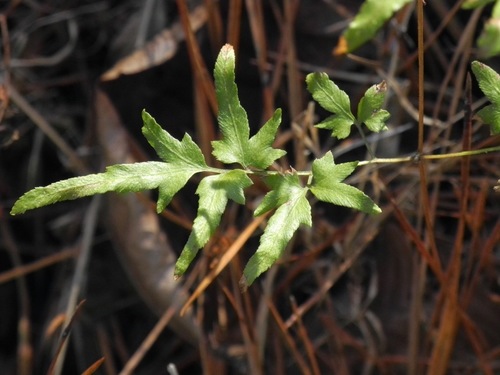
Lygodium is a genus of about 40 climbing ferns in the family Lygodiaceae, found across tropical and warm-temperate regions of the world. Unlike most ferns, the frond has an indeterminate rachis that twines around supports and elongates continuously, letting individual fronds climb 3-30 ft (1-9 m) and, in L. microphyllum, scramble 90 ft (27 m) or more into tree canopies. The true stem is a slender creeping rhizome at ground level; what looks like a vining stem is a single extended frond bearing many small leaflets along its length. Leaflets are typically lobed or palmately divided, 0.8-3 in (2-8 cm) long, in shades of green. Fertile leaflets carry rows of sporangia along their margins rather than in discrete sori. Several species, including L. japonicum and L. microphyllum, are listed as invasive or noxious weeds in the southeastern United States, where they smother native vegetation and carry fire into tree canopies. The North American native L. palmatum grows in moist, acidic woodlands. Across the genus, foliage ranges from evergreen in tropical species to deciduous in temperate ones.
Native Range
Lygodium occurs through the tropics and subtropics of Asia, Africa, Australia, and the Americas, with a few species reaching warm-temperate zones. L. palmatum is native to the eastern United States, while L. japonicum and L. microphyllum are native to Asia, Africa, and Oceania and naturalized in the southeastern United States.Suggested Uses
The native L. palmatum grows in shaded, moist woodland and native-plant gardens, where its slender climbing fronds cover low supports. Tropical species are grown on trellises in greenhouses and frost-free gardens. Planting of L. japonicum and L. microphyllum is prohibited in several southeastern states because of their invasive spread.How to Identify
Appearance
Size & Dimensions
Height3' - 30'
Width/Spread3' - 6'
Bloom Information
As a fern, Lygodium produces no flowers and reproduces by spores. Sporangia mature along the margins of fertile leaflets, mainly in late summer and autumn in temperate species and through much of the year in the tropics. Spores are dispersed by wind.
Detailed Descriptions
Foliage Description
greenGrowing Conditions
Sun Requirements
Requires 2-6 hours of direct sunlight daily
• Full Sun: 6+ hours of direct sunlight
• Partial Shade: 3-6 hours of direct sunlight
• Full Shade: Less than 3 hours of direct sunlight
Water & Climate
Water Needs
Care & Maintenance
Care Guide
Climbing ferns grow in part shade to filtered sun in consistently moist, acidic soil rich in organic matter, with a pH near 5.0 to 6.5. They establish along woodland edges, stream banks, and fences where the twining fronds find support. The native L. palmatum needs cool, humid, undisturbed conditions and is intolerant of root disturbance, while tropical species tolerate a wider range. Cold tolerance spans roughly USDA zones 6 to 11 across the genus. Invasive species spread rapidly by wind-borne spores and rhizome growth and are restricted from sale in several states. A trellis or other support accommodates the climbing fronds.Pruning
Dead and frost-killed fronds are cut back to the rhizome in late winter before new growth emerges. For invasive species, fronds are removed and bagged before spores mature to limit spread. No routine shaping is needed beyond managing the climbing fronds on their support.Container Growing
Suitable for container growing
Minimum container size: 3 gallons
