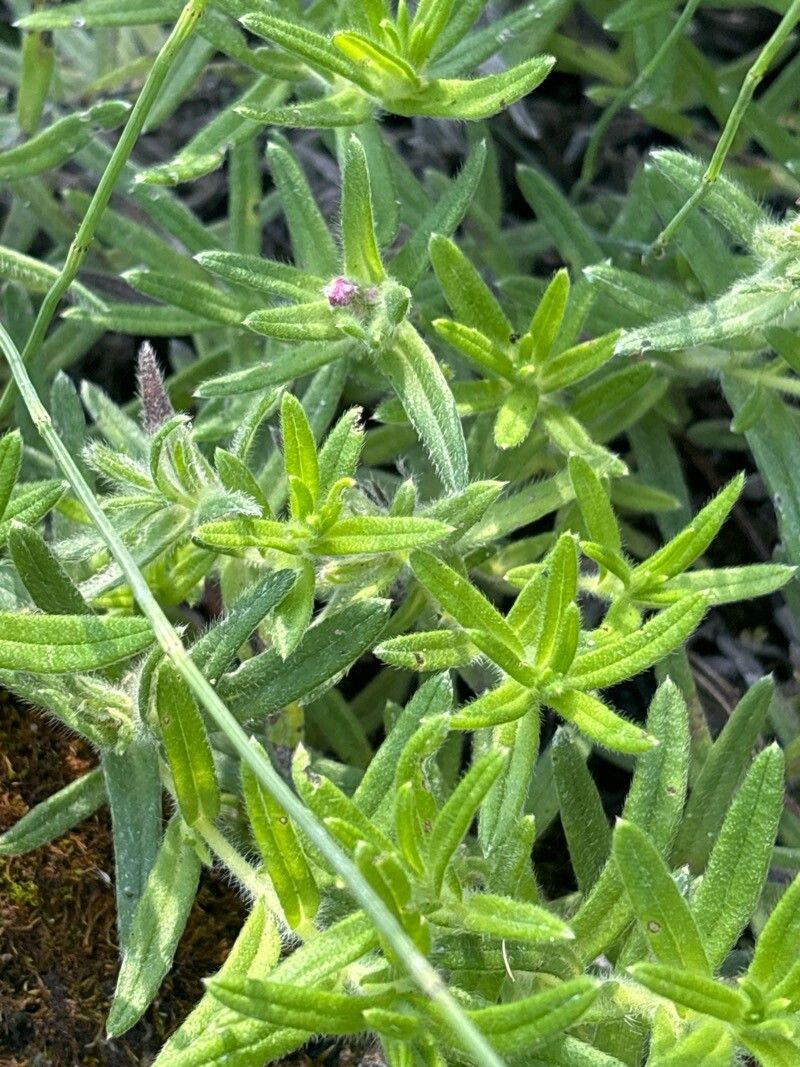
Lithodora diffusa
lithodora
Southwestern Europe — Iberian Peninsula (Spain, Portugal) and southwestern France; acidic well-drained rocky slopes, heathland, and open scrub
Overview
Lithodora diffusa (lithodora, purple gromwell) is a low spreading evergreen perennial growing 4–6 inches (10–15 cm) tall and 18–24 inches (45–60 cm) wide, forming a dense prostrate mat of trailing stems. Deep azure-blue 5-petaled funnel-shaped flowers 0.5 inch (12 mm) appear in clusters at stem tips from April through June for about 8 weeks, with sporadic rebloom possible after shearing. Leaves are dark green, narrow lance-shaped, 0.5–1 inch (12–25 mm), with rough hairy texture typical of Boraginaceae spp., densely arranged on prostrate stems. The species belongs to Boraginaceae spp.; Lithodora derives from Greek lithos (stone) and doron (gift), referring to the rocky habitat. Native to the Iberian Peninsula (Spain, Portugal) and southwestern France, on acidic well-drained rocky slopes, heathland, and open scrub. The strict acid soil requirement (pH 4.5–6.0) is the principal cultural limitation — chlorosis and decline develop in neutral or alkaline conditions. Cultivars include 'Grace Ward' (more vigorous spreader), 'Heavenly Blue' (the standard selection), and 'White Star' (white flowers). Drought-tolerant once established. Hard pruning into bare older wood produces limited regeneration — another practical limitation. Deer-resistant. Non-toxic. Hardy in zones 6–8.
Native Range
Native to the Iberian Peninsula (Spain, Portugal) and southwestern France, on acidic well-drained rocky slopes, heathland, and open scrub.Suggested Uses
Used as a low evergreen groundcover in rock gardens, on well-drained slopes, in raised beds filled with acidic soil mix, and in containers of at least 2 gallons (7.5 L), spaced 18–24 inches (45–60 cm). The strict acid soil requirement restricts in-ground siting to naturally acidic soils or amended beds. Non-toxic. Zones 6–8.How to Identify
Appearance
Size & Dimensions
Height4" - 6"
Width/Spread1'6" - 2'
Reaches mature size in approximately 2 years
Bloom Information
Spring to early summer (April–June) over about 8 weeks. Deep azure-blue 5-petaled funnel-shaped flowers 0.5 inch (12 mm) in clusters at stem tips. Bee- and butterfly-visited. Sporadic rebloom possible after shearing spent stems in late June or July.
Detailed Descriptions
Flower Description
Deep azure-blue; 5-petaled; funnel-shaped; 0.5 inch (12 mm); in clusters at stem tips; April-JuneFoliage Description
Dark green; narrow lance-shaped; 0.5-1 inch (12-25 mm); rough hairy texture typical of Boraginaceae; densely arranged on prostrate trailing stems; evergreen year-roundGrowing Conditions
Sun Requirements
Requires 4-10 hours of direct sunlight daily
• Full Sun: 6+ hours of direct sunlight
• Partial Shade: 3-6 hours of direct sunlight
• Full Shade: Less than 3 hours of direct sunlight
Care & Maintenance
Care Guide
Grows in full sun to partial shade with 4–10 hours of direct light. Requires acidic well-drained soil at pH 4.5–6.0 in loam, sand, or rocky substrate — chlorosis and decline develop in neutral or alkaline conditions. Drought-tolerant once established. Lightly shear after flowering in June–July to maintain compact form and encourage sporadic rebloom. Hard pruning into bare older wood produces limited regeneration. Deer-resistant. Non-toxic. Suitable for zones 6–8.Pruning
Lightly shear after flowering in June–July to maintain a compact form and encourage sporadic rebloom. Cuts should remain within leafy growth — hard pruning into bare older wood produces limited and inconsistent regeneration.Pruning Schedule
J
F
M
A
M
J
J
A
S
O
N
D
summer
Container Growing
✓ Suitable for container growing
Minimum container size: 2 gallons