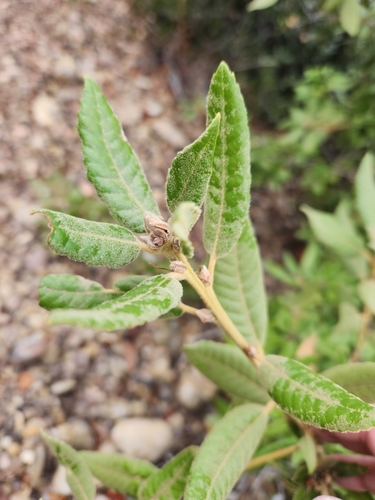
© Joseph O'Brien, USDA Forest Service, some rights reserved (CC-BY) · Wikimedia Commons
Lithocarpus densiflorus
Tanoak
Pacific Coast N America (SW Oregon to S California; Coast Ranges, Klamath Mts, Sierra Nevada foothills; mixed evergreen forests, redwood understory; sea level to 5000 ft / 1500 m)
Overview
Lithocarpus densiflorus (recently reclassified as Notholithocarpus densiflorus based on molecular phylogenetic work separating it from Asian Lithocarpus spp.) is a large evergreen tree reaching 40–80 feet (12–24 m) tall with a spread of 30–50 feet (9–15 m) and a broad rounded crown. The species is the only member of Notholithocarpus spp. in North America and fills an evolutionary intermediate position between the true oaks (Quercus spp.) and the Asian stone oaks (Lithocarpus spp. sensu stricto). Thick leathery oblong-elliptic leaves 2–5 inches (5–13 cm) long carry prominent parallel veins and toothed margins, run dark green on the upper surface, and emerge densely woolly-white (tomentose) beneath—the tomentum thins with leaf age but some persists through the leaf lifespan as a diagnostic character. Upright stiff catkin-like flower spikes 2–4 inches (5–10 cm) long are cream to pale yellow and open in spring. Acorn-like fruit sits in a shallow spiny cup 0.5–0.8 inches (12–20 mm) across and matures over two full growing seasons from flower to seed release. Gray bark develops shallow furrows with tree age. Growth rate is slow to moderate. Susceptible to sudden oak death (Phytophthora ramorum), which has caused widespread mortality across the species' native range since the late 1990s. Hardy to zone 7.
Native Range
Lithocarpus densiflorus is native to the Pacific Coast of North America, ranging from southwestern Oregon south through the Coast Ranges, Klamath Mountains, and Sierra Nevada foothills into the Transverse Ranges of southern California. The species grows in mixed evergreen forests, redwood (Sequoia sempervirens) understory, and oak woodlands at elevations from sea level to 5,000 feet (1,500 m). Bark was historically harvested as a commercial source of tannin for leather processing—the common name 'tanbark oak' and specific epithet 'densiflorus' both reference this historical use, though the industry declined through the 20th century as synthetic tannins replaced bark extraction.Suggested Uses
Planted as a specimen, shade tree, or component of Pacific Coast native plant gardens at 30–40 foot (9–12 m) spacing in zone-7-and-warmer maritime climates. The evergreen canopy supplies year-round shade and structural mass in large-garden positions. Native provenance fits the species to Pacific Northwest and northern California native-plant garden designs and habitat-restoration plantings. Susceptibility to sudden oak death limits the species' use in any region with confirmed Phytophthora ramorum infestation—planting decisions in affected areas require consultation with local plant pathology resources. Slow growth rate extends the establishment timeline across many years. Alkaline soils, dry sites, Phytophthora ramorum-infested regions, and climates outside the Pacific Coast maritime zone are poor fits for the species.How to Identify
Appearance
Size & Dimensions
Height40' - 80'
Width/Spread30' - 50'
Reaches mature size in approximately 25 years
Bloom Information
Upright stiff catkin-like flower spikes 2–4 inches (5–10 cm) long open from April through June, cream to pale yellow in color and carrying a pungent characteristic odor that separates the species from true oaks on scent alone. The species is monoecious, with male and female flowers produced on the same tree. Acorn-like fruit in spiny cups matures over two full growing seasons—flowers produced in spring develop into mature acorns 18–24 months later, which is slower than the single-season acorn maturation of most Quercus spp. species. Active flower bloom duration is 3–4 weeks.
Detailed Descriptions
Flower Description
Cream to pale yellow upright stiff catkins 2-4 inches; pungent odor; spiny-cupped acornsFoliage Description
Dark green above, woolly-white (tomentose) beneath when young; thick leathery oblong-elliptic 2-5 inches; prominent parallel veins; toothed marginsGrowing Conditions
Sun Requirements
Requires 4-8 hours of direct sunlight daily
• Full Sun: 6+ hours of direct sunlight
• Partial Shade: 3-6 hours of direct sunlight
• Full Shade: Less than 3 hours of direct sunlight
Care & Maintenance
Care Guide
Partial shade to full sun in moist well-drained acidic soil (pH 5.0–6.5) matches the species' cultivation needs. Hardy to zone 7 (0°F / −18°C). The native Pacific Coast forest ecology gives the species good shade tolerance, particularly through the juvenile establishment years when young plants persist in deep redwood-understory shade. Consistent soil moisture runs through the active growing season. Sudden oak death (Phytophthora ramorum) infection is the primary threat to established trees—the disease is fatal and has caused mass mortality across the species' native range since the late 1990s, with no cure available. First-year establishment runs slow, and plantings require multiple seasons to reach independent functioning.Pruning
Pruning runs minimal—the natural form develops into a broad rounded crown through unassisted growth. Dead, crossing, or damaged branches are removed in late winter while the tree is dormant. Limbing up the lowest branches creates walk-under clearance beneath the canopy on mature specimens. Topping and heavy-pruning operations produce slow recovery and weak regrowth and are avoided.Pruning Schedule
J
F
M
A
M
J
J
A
S
O
N
D
winter