Overview
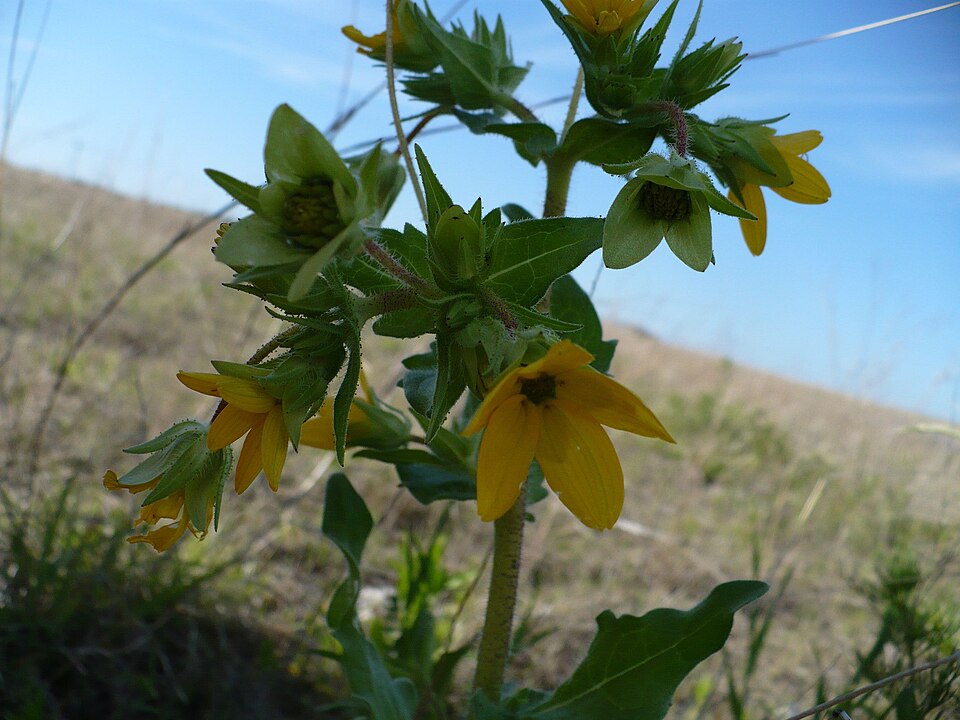
Lindheimera texana is a cool-season annual in the aster family, forming branched, hairy stems 1-2 feet (30-60 cm) tall. The lower leaves are lobed or coarsely toothed and the upper leaves narrower, all covered with stiff hairs. The flower heads are about 1 inch (2.5 cm) across, with five broad yellow ray florets, each notched at the tip, arranged so the head reads as a five-pointed star around a small yellow disc. Heads open from early to late spring. The fruit is a flat, winged seed. It is native to Texas and nearby areas, growing on limestone and other calcareous soils in prairies, open fields, and along roadsides, often in large drifts. As a cool-season annual it germinates in fall, grows over winter, flowers in spring, and dies by early summer, so its display is brief and tied to fall and winter moisture.
Native Range
Lindheimera texana is native to Texas and adjacent Oklahoma and northern Mexico. It grows on limestone and calcareous soils in prairies, open fields, and along roadsides.Suggested Uses
Used in wildflower meadows, prairie plantings, and naturalized areas on alkaline soil, where it forms spring drifts. The flowers draw bees and other small pollinators. It is sown in fall directly where it is to grow.How to Identify
Appearance
Size & Dimensions
Height1' - 2'
Width/Spread8" - 1'2"
Bloom Information
Flower heads open in spring, generally March to May. A plant blooms over about 4-6 weeks, with new heads forming as older ones fade. Bloom depends on fall and winter rainfall and ends as summer heat arrives.
Detailed Descriptions
Foliage Description
greenGrowing Conditions
Sun Requirements
Requires 6-12 hours of direct sunlight daily
• Full Sun: 6+ hours of direct sunlight
• Partial Shade: 3-6 hours of direct sunlight
• Full Shade: Less than 3 hours of direct sunlight
Water & Climate
Water Needs
Drought Tolerance
Drought tolerant when established
Care & Maintenance
Care Guide
Grows in full sun in well-drained, neutral to alkaline soil with a pH near 6.5-8.0, and does well on limestone and clay. As a cool-season annual it is sown in fall, grows through winter as a rosette, and flowers in spring. It needs little water beyond winter rainfall and no feeding. Heat and drought end the season and the plant sets seed and dies. It reseeds readily where the ground stays open.Pruning
No pruning is needed. Plants can be left to set seed for next year''s stand or pulled after flowering. Removing spent plants before seed drop reduces self-sowing.Container Growing
Suitable for container growing
Minimum container size: 1 gallons
Toxicity
Non-toxicPlanting Guide
Planting Methods & Timing
Planting Method
direct sow
Direct Sow Timing
Sow in fall on bare, well-drained soil for spring bloom
Days to Maturity
150–210 days
Plant Spacing
8 inches