Image 1 of 8
1 / 8
© Ratabago from Adelaide, Australia, some rights reserved (CC-BY-SA) · Wikimedia Commons
Leptoceras, Genus, menziesii, Species,
- Genus & species
rabbit orchid
Overview
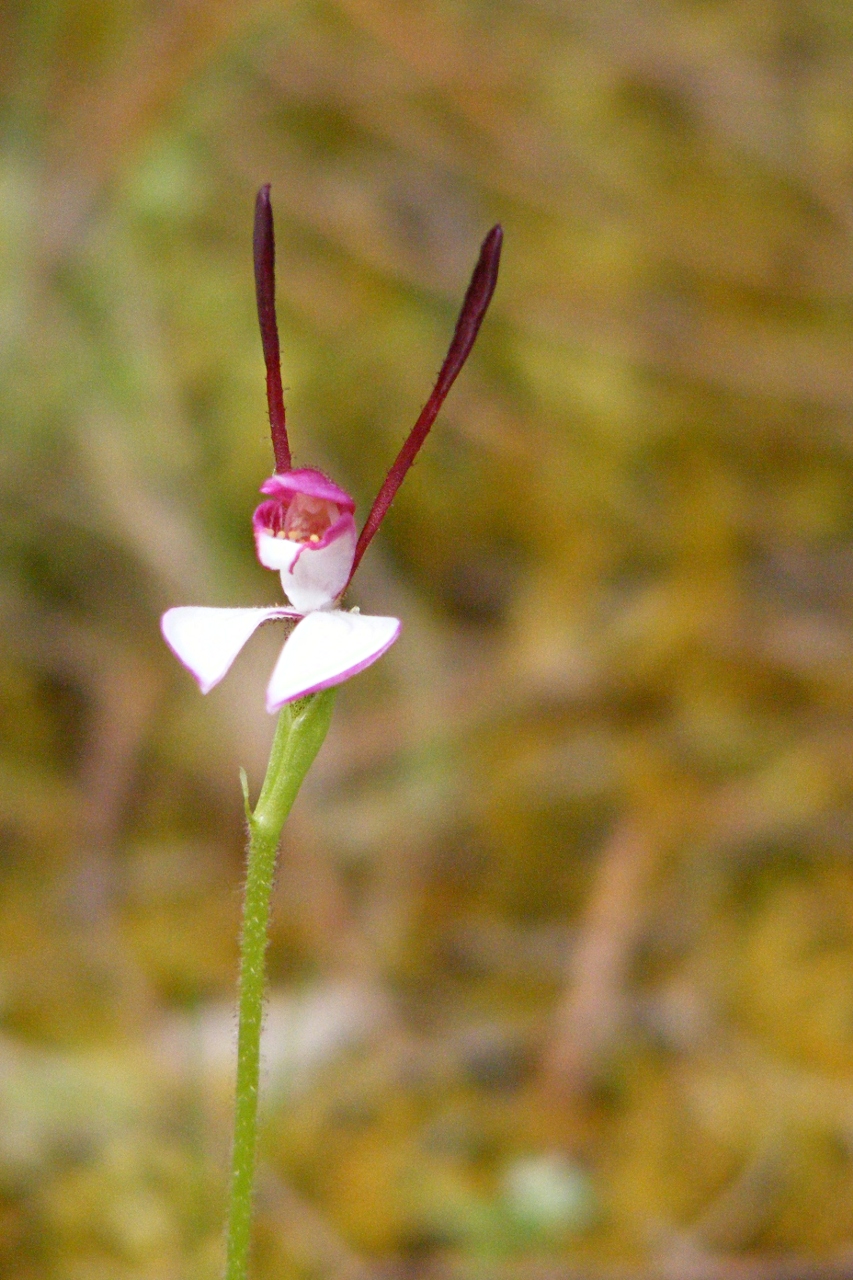
Leptoceras menziesii is a deciduous terrestrial orchid growing from an underground tuberoid, reaching 3-10 inches (8-25 cm) tall in flower. Each plant produces a single ground-hugging leaf, linear to lance-shaped, 1.2-3 inches (3-8 cm) long, green above and often reddish below. One to four flowers are carried on a slender stem, each 0.6-1 inch (1.5-2.5 cm) across, white to pale pink, with two narrow petals held erect above the flower and a small labellum striped red. Flowering occurs in spring. After flowering the plant dies back and stays dormant through the dry summer as a tuberoid. Growth depends on symbiotic soil fungi, which makes the species hard to transplant or cultivate outside its natural habitat. Colonies form slowly from daughter tubers.
Native Range
Native to southern Australia, including Western Australia, South Australia, Victoria, Tasmania, and southern New South Wales. Grows in sandy or gravelly soils in heathland, shrubland, and open eucalypt woodland, often appearing in numbers in the season after a summer bushfire.Suggested Uses
Grown by orchid growers in deep pots of free-draining sandy mix that can be kept dry over summer. In natural plantings it occurs in undisturbed heath and woodland. It is not suited to general garden beds because of its fungal dependence and summer dormancy.How to Identify
Appearance
Size & Dimensions
Height3" - 10"
Width/Spread2" - 4"
Bloom Information
Flowers in spring, September through November depending on latitude and altitude. Each flower lasts 1-2 weeks, with the whole display extending 3-4 weeks. Flowering increases markedly in the season following a summer fire.
Detailed Descriptions
Flower Description
white to pale pinkFoliage Description
green with reddish undersideGrowing Conditions
Sun Requirements
Requires 4-8 hours of direct sunlight daily
• Full Sun: 6+ hours of direct sunlight
• Partial Shade: 3-6 hours of direct sunlight
• Full Shade: Less than 3 hours of direct sunlight
Care & Maintenance
Care Guide
Grows in full sun to dappled shade in free-draining sandy soils that dry out over summer. The species depends on specific mycorrhizal fungi and rarely survives transplanting from the wild. Plants need an open, competition-free position and a dry summer dormancy. Excess summer water rots the dormant tuberoid. Cultivation is generally limited to growers using symbiotic propagation techniques.Pruning
No pruning is required. Spent flower stems wither naturally as the plant enters summer dormancy. Dead foliage can be left in place to protect the dormant tuberoid.Container Growing
Suitable for container growing
Minimum container size: 1 gallons