Lepechinia, Genus, calycina, Species,
- Genus & species
California pitcher sage
California Coast Ranges and Sierra Nevada foothills
Overview
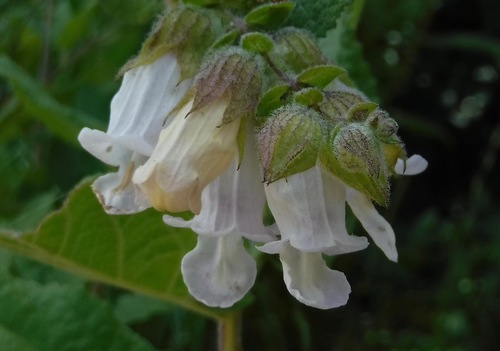
Lepechinia calycina is an aromatic semi-evergreen shrub in the mint family, reaching 2-5 feet (0.6-1.5 m) tall and 3-6 feet (0.9-1.8 m) wide with a loose, mounding to spreading habit and the square stems typical of the family. The wrinkled, gray-green leaves are 1-3.5 inches (2.5-9 cm) long, lance-shaped, and softly hairy, releasing a strong balsamic scent when bruised. From March to June it carries tubular, bell-shaped flowers about 0.75-1 inch (2-2.5 cm) long, white to pale lavender, nodding from the leaf axils within inflated, cup-like calyces that give the plant its common name. Bumblebees and hummingbirds work the flowers, which are followed by dry nutlets held in the persistent papery calyces. The foliage is rich in aromatic oils and is largely passed over by deer and grazing animals. It grows on dry, shaded to open slopes in chaparral, oak woodland, and coniferous forest edges of the California Coast Ranges and Sierra Nevada foothills. Growth is rapid in spring, after which the shrub goes semi-dormant through the dry summer and may shed older leaves. Stems turn woody and somewhat sprawling with age, and plants are naturally short-lived, persisting roughly 6-10 years.
Native Range
Native to California, where it grows in the Coast Ranges and the foothills of the Sierra Nevada. It occupies dry chaparral, oak woodland, and the margins of coniferous forest, often on rocky or partly shaded slopes below about 5,000 feet (1,500 m). Its range is centered in central and northern California.Suggested Uses
Lepechinia calycina is used in native, water-thrifty, and pollinator gardens, on dry banks, and as an informal filler among chaparral shrubs. Its aromatic foliage and deer resistance suit unfenced slopes and woodland edges. It combines with manzanita, ceanothus, and California fuchsia in low-water plantings.How to Identify
Appearance
Size & Dimensions
Height2' - 5'
Width/Spread3' - 6'
Colors
Bloom Information
Flowering runs from March to June, peaking in mid to late spring. The nodding bell-shaped flowers open in succession along the upper stems over six to eight weeks. Bloom is fullest in open, sunny positions and tapers as summer drought arrives.
Detailed Descriptions
Flower Description
white to pale lavenderFoliage Description
gray-greenGrowing Conditions
Sun Requirements
Requires 5-10 hours of direct sunlight daily
• Full Sun: 6+ hours of direct sunlight
• Partial Shade: 3-6 hours of direct sunlight
• Full Shade: Less than 3 hours of direct sunlight
Care & Maintenance
Care Guide
Lepechinia calycina grows in full sun to part shade on well-drained rocky, sandy, or loamy soil with a pH from about 6.0 to 7.5. Once established it needs little to no summer water and can rot if irrigated through hot, dry months. Plants set out in autumn make roots over the wet season and settle in before their first summer. It tolerates heat, drought, and lean soils and is root-hardy in USDA zones 8-10, taking brief frost to around 20 F (-7 C). Light shade holds the foliage longer through summer, while full sun brings heavier bloom and a more compact form. Fertilizer is seldom required, and lean soils produce sturdier growth.Pruning
Light cutting back after flowering removes spent stems and keeps the form compact, since the shrub grows open and sprawling with age. Hard renewal pruning in late winter draws fresh basal shoots from older plants. The aromatic foliage scents the air and hands during pruning.Container Growing
Suitable for container growing
Minimum container size: 5 gallons