Lapsana, Genus, communis, Species,
- Genus & species
nipplewort
Europe and western Asia; naturalized in the Pacific Northwest and northeastern North America in moist partially shaded urban and suburban habitats
SunPart Shade – Full Sun
WaterMedium
Overview
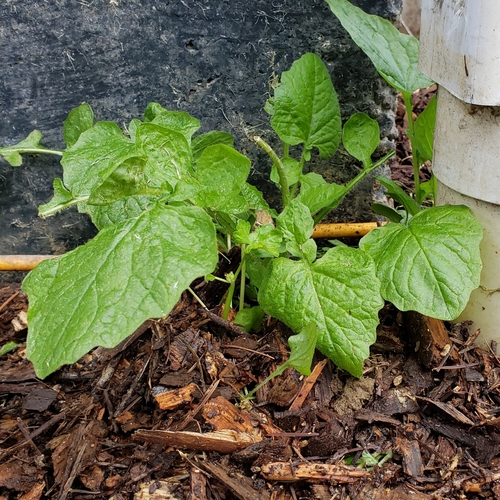
Lapsana communis is a slender branching annual weed in the daisy family (Asteraceae) reaching 12–48 inches (30–120 cm) tall and 8–18 inches (20–45 cm) wide. Stems are erect, branching, softly hairy below and smooth above. Lower leaves are lyrate — a leaf shape with a terminal lobe much larger than the lateral lobes — measuring 2–6 inches (5–15 cm) long with a large ovate terminal lobe and 1–4 pairs of smaller lateral lobes along the petiole. Upper stem leaves are simple, ovate, with toothed margins. Unlike most members of the subfamily Cichorioideae in Asteraceae, stems do not exude milky latex when broken — an absence that separates this species from Lactuca, Sonchus, Crepis, Hieracium, and Taraxacum, all of which release white latex from cut stems. Flower heads are small, 0.3–0.5 inch (8–12 mm) across, with 8–15 yellow ligulate florets, borne in loose open panicles. Fruit is a cylindrical achene without a pappus — seeds fall near the parent plant at 6–24 inches (15–60 cm) distance rather than dispersing widely by wind like most related genera. A single plant produces 500–3,000 seeds. Seeds germinate primarily in autumn, and seedlings overwinter as small rosettes before bolting the following spring. Common in gardens, hedgerows, woodland edges, and shaded urban areas across the Pacific Northwest and temperate Europe. Not known to be toxic to pets or humans.
Native Range
Lapsana communis is native to Europe and western Asia, occurring in hedgerows, woodland margins, gardens, and shaded waste ground from sea level to approximately 5,000 feet (1,500 m) elevation. The species is widely naturalized in the Pacific Northwest and northeastern North America, particularly in moist partially shaded urban and suburban habitats where garden cultivation and woodland edge conditions intersect.Suggested Uses
Used in Asteraceae weed identification courses for teaching the no-latex, no-pappus trait combination — distinct among common yellow-flowered Asteraceae weeds and diagnostic for Lapsana communis. The lyrate leaf shape is used in leaf-morphology exercises on terminal-lobe dominance. Included in comparative identification exercises alongside Lactuca, Sonchus, Crepis, and Mycelis to teach the milky-latex test (break a stem — latex present or absent in 30 seconds) as a quick field identification technique. Young leaves are edible and historically consumed as a potherb in Europe — the common name 'nipplewort' references the traditional medicinal use for sores on the breast, though no modern medical evidence supports that application.How to Identify
Appearance
Size & Dimensions
Height1' - 4'
Width/Spread8" - 1'6"
Bloom Information
Small yellow flower heads 0.3–0.5 inch (8–12 mm) across with 8–15 ligulate florets in loose open panicles appear from June through August. Individual flower heads open for one morning and close by afternoon — a behavior shared across many yellow-flowered Asteraceae. The loose panicle produces heads sequentially over a 4–6 week bloom window. The species is self-pollinating. Seeds mature 2 weeks after flowering and fall near the parent plant rather than dispersing on wind since no pappus is present. In the Pacific Northwest, peak flowering runs July.
Detailed Descriptions
Flower Description
Yellow; small flower heads 0.3-0.5 inch across with 8-15 ligulate florets in loose open panicles; June-AugustFoliage Description
Medium green; lower leaves lyrate 2-6 inches long with a large ovate terminal lobe and 1-4 pairs of smaller lateral lobes; upper leaves simple ovate with toothed marginsGrowing Conditions
Sun Requirements
Requires 3-8 hours of direct sunlight daily
• Full Sun: 6+ hours of direct sunlight
• Partial Shade: 3-6 hours of direct sunlight
• Full Shade: Less than 3 hours of direct sunlight