Lamprocapnos, Genus, spectabilis, Species,
- Genus & species
bleeding heart
Shaded moist mountain woodland and forest margins across Siberia, northeastern China (Manchuria), Korea, and Japan
Overview
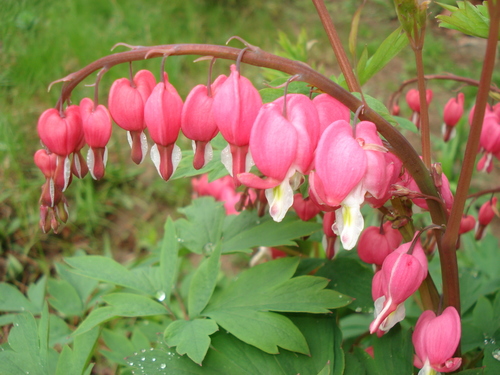
Lamprocapnos spectabilis is a mounding deciduous perennial in the family Papaveraceae growing 18–36 inches (45–90 cm) tall in bloom and 18–24 inches (45–60 cm) wide from a fleshy rhizomatous crown. The species was classified under Dicentra for nearly two centuries (as Dicentra spectabilis), and phylogenetic work in the early 2000s transferred it to the monotypic genus Lamprocapnos because it differs from the true Dicentra species in flower and seed structure — most older garden references, nursery labels, and seed packets still carry the older Dicentra spectabilis name. Foliage is blue-green with a glaucous waxy surface, deeply divided into three main segments that are further subdivided into lobes, and carried on fleshy hollow petioles that snap cleanly when crushed. Pendant heart-shaped flowers 1–1.5 inches (2.5–4 cm) long open along arching flowering stems in April and May across a 3–4 week bloom period: each flower has two inflated rose-pink outer petals fused at the base into a heart outline, with two narrow white inner petals projecting from the bottom of the heart as a suspended drop — the heart-and-drop flower form is not matched by any other commonly cultivated garden perennial and is the source of the common name bleeding heart. Each flowering stem carries 10–20 flowers along its arching length, and the flowers open sequentially from the stem base toward the tip over several weeks. Limitation: the species goes fully summer-dormant as soil temperatures rise and soil moisture drops — foliage yellows in June and the entire above-ground plant has died back to the crown by July in hot dry conditions, leaving a vacant garden position that stays bare until the following spring. In cool moist maritime climates the foliage persists into late summer, but in most continental temperate gardens the summer dormancy gap calls for companion plantings that emerge or fill out during June and July, typically Hosta, Astilbe, Epimedium, and woodland ferns that spread into the vacated space. The fleshy root system resents disturbance, and established clumps are rarely divided because the brittle roots break during the lifting process and the plant can take 2–3 years to recover from a transplant. All parts of the plant contain isoquinoline alkaloids related to those found in opium poppies, and the sap causes skin irritation on contact with sensitive individuals and gastrointestinal distress if ingested by humans, dogs, or cats. Deer-resistant because of the alkaloid content. Hummingbird-visited during the spring bloom period.
Native Range
Native to shaded moist mountain woodland and forest margins across Siberia, northeastern China (Manchuria), Korea, and Japan, growing in the understory of deciduous and mixed forest canopies on humus-rich substrates with consistent spring moisture. The species was collected by Robert Fortune in the 1840s from a garden on the island of Zhoushan off the coast of China and introduced to western European horticulture in 1846, where it became a cottage-garden staple through the Victorian era and has been continuously in cultivation since that introduction.Suggested Uses
Used in shade borders, woodland gardens, cottage gardens, and foundation plantings under deciduous trees in USDA zones 3 through 9 at 18–24 inch (45–60 cm) spacing in groups of 3 or more for a cohesive spring display. The summer dormancy gap calls for companion plantings of Hosta, Astilbe, Epimedium, and woodland ferns that emerge or fill out during June and July as the bleeding heart foliage dies back. The cut flowering stems last 7–10 days in a vase and are used for spring arrangements in Japanese-influenced and cottage-garden design styles. Gardens where pet or child access is a concern are unsuitable because all parts of the plant contain isoquinoline alkaloids and the sap causes skin irritation and gastrointestinal distress, and handling of the foliage during weeding or dividing is better done with gloves for sensitive individuals.How to Identify
Appearance
Size & Dimensions
Height1'6" - 3'
Width/Spread1'6" - 2'
Bloom Information
Pendant heart-shaped flowers 1–1.5 inches (2.5–4 cm) long open along arching flowering stems in April and May across a 3–4 week bloom period, and each flowering stem carries 10–20 flowers that open sequentially from the stem base toward the tip. Hummingbirds work the flowers for nectar and are the main pollinators in temperate gardens where the species is cultivated. After bloom the flowering stems ripen and carry narrow seed pods that release small black seeds in June, and the foliage ripens and yellows in June before the plant enters summer dormancy.
Detailed Descriptions
Flower Description
rose-pink 2-inflated-outer-petal heart shape with 2 white inner petals projecting from the bottom as a suspended drop; the cultivar 'Alba' opens pure white; the cultivar 'Valentine' opens dark red with dark red stemsFoliage Description
blue-green with a glaucous (waxy) surface; deeply divided into three main segments and further subdivided into lobes, carried on fleshy hollow petioles; the cultivar 'Gold Heart' carries golden-yellow foliage that holds the color through spring and fades toward green by midsummerGrowing Conditions
Sun Requirements
Requires 2-5 hours of direct sunlight daily
• Full Sun: 6+ hours of direct sunlight
• Partial Shade: 3-6 hours of direct sunlight
• Full Shade: Less than 3 hours of direct sunlight
Care & Maintenance
Care Guide
Site in partial shade to full shade with 2–5 hours of direct sun per day, and morning sun with afternoon shade is the suited exposure in warm climates where afternoon heat accelerates the summer dormancy and shortens the spring display. Humus-rich well-drained soil with a pH of 5.5–7.0 holds the crown through winter without rot, and the species calls for consistent moisture through the April and May bloom period to support flower production and foliage expansion. The species enters summer dormancy as soil temperatures rise and soil moisture drops: foliage yellows in June and the above-ground plant dies back to the crown by July in hot dry conditions, leaving a vacant garden position until the following spring. Companion plantings of Hosta, Astilbe, Epimedium, and woodland ferns fill the summer dormancy gap. Mark the dormant crown position with a label or stake so the position is not disturbed by later garden work. The fleshy root system resents disturbance and established clumps are rarely divided. All parts of the plant contain isoquinoline alkaloids — the sap causes skin irritation on contact with sensitive individuals and gastrointestinal distress if ingested by humans, dogs, or cats. Hardy in USDA zones 3–9.Pruning
Foliage is allowed to yellow and die back naturally in June and July as the plant enters summer dormancy, and the cut-back is done only after the foliage has fully yellowed because premature removal of green foliage reduces the crown's stored energy for the following spring. Once the foliage is fully yellow, the dead stems are cut to the ground and removed to the compost pile. Division is rarely needed and is avoided where possible because the brittle fleshy roots break during lifting and the plant takes 2–3 years to recover from the disturbance; if division is unavoidable, it is done in early spring (March or April) as new growth emerges and the crown is lifted with as much soil as possible to hold the root system intact.Pruning Schedule
Prune: June–July
summer