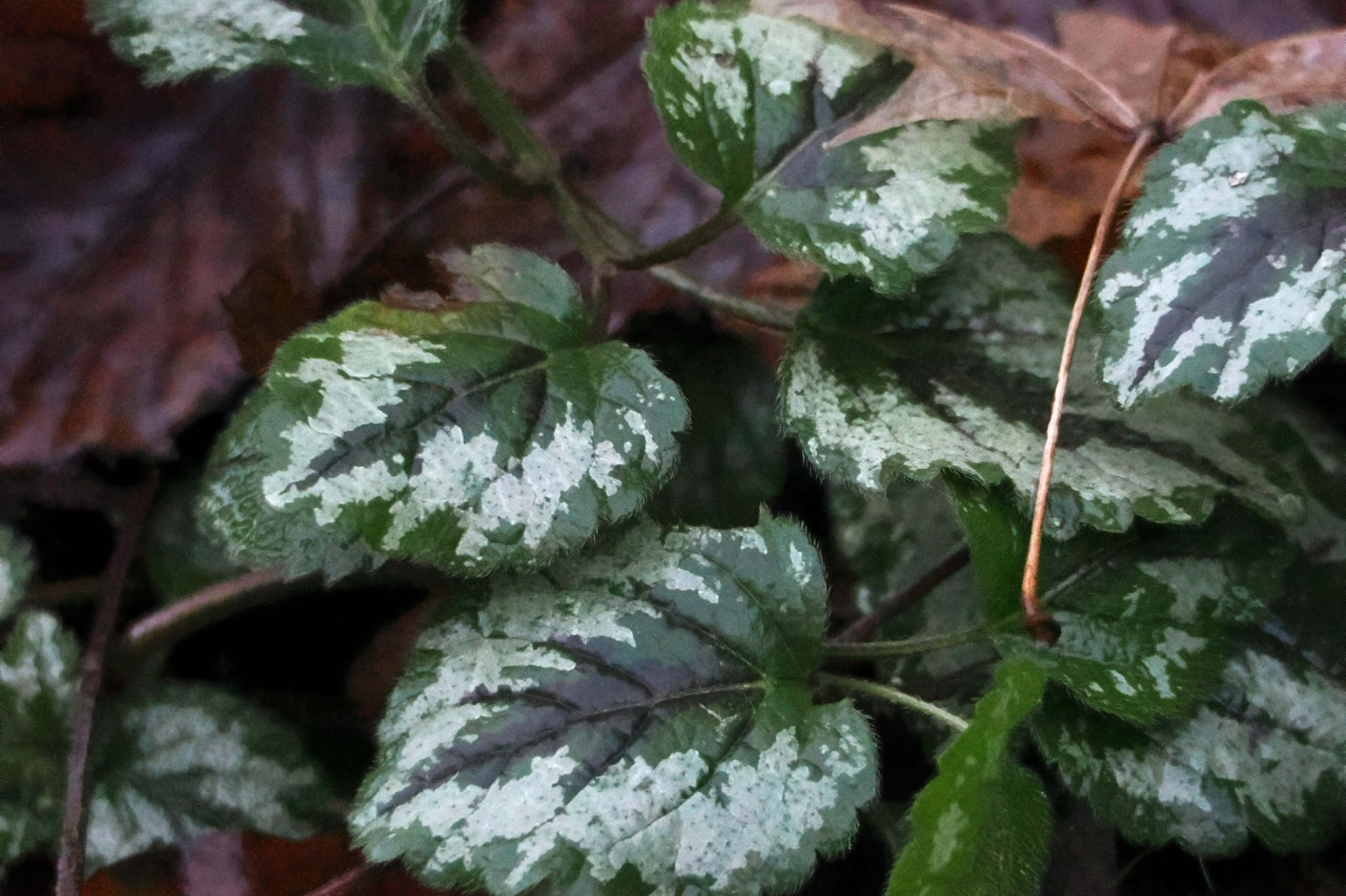
Lamiastrum galeobdolon
yellow archangel
Europe and western Asia; naturalized in the Pacific Northwest (southern British Columbia through western Washington and Oregon to northern California)
Overview
Lamiastrum galeobdolon (synonym Lamium galeobdolon) is a stoloniferous evergreen perennial ground cover in the mint family (Lamiaceae) reaching 8–24 inches (20–60 cm) tall and spreading 2–6 feet (0.6–1.8 m) wide per year via long above-ground stolons. Stems are square in cross-section — the Lamiaceae diagnostic. Leaves are opposite, ovate to triangular, 1–3 inches (2.5–8 cm) long, with crenate-serrate margins. The cultivated form most commonly escaped in the Pacific Northwest is the variegated cultivar (sold as L. galeobdolon 'Hermann's Pride' or 'Variegatum'), with dark green leaves bearing conspicuous silvery-white splotches that carry year-round identification value. Flowers are yellow, two-lipped, 0.6–0.8 inch (15–20 mm) long, with brown markings on the lower lip, borne in whorls of 4–8 in the upper leaf axils in late spring. Stolons run long and arching, rooting at the nodes, extending 3–6 feet (0.9–1.8 m) per year under favorable conditions. Stolon fragments as short as 2 inches (5 cm) with a single node regenerate into new plants, making fragment-driven spread the principal mechanism by which the species invades beyond cultivated positions. Dense mat-forming colonies smother native ground cover in forest understory positions and reduce native-plant diversity by 60–80% across invaded patches within 3–5 years of establishment. Listed as a Class B noxious weed in Washington State. Not known to be toxic to pets or humans.
Native Range
Lamiastrum galeobdolon is native to Europe and western Asia, occurring in deciduous woodlands and hedgerows from sea level to approximately 5,000 feet (1,500 m) elevation. The species was introduced to North America as an ornamental ground cover; the variegated cultivars escaped and naturalized in the Pacific Northwest, particularly in urban forests, municipal parks, and riparian areas west of the Cascades, from southern British Columbia through western Washington and Oregon to northern California.Suggested Uses
Used in noxious weed identification training for Pacific Northwest urban foresters, park managers, and municipal natural-area staff. A primary case study in the garden-escape pathway for invasive species introduction — the species illustrates the gap between legal retail sale and ecological impact that characterizes many Class B and Class C ornamental invasives. Studied in shade-tolerant ground cover invasion ecology, specifically the mat-forming displacement of native herbaceous layers under deciduous tree canopies. The Lamiaceae square stem and two-lipped flower morphology are taught in plant family identification exercises alongside Salvia spp., Nepeta spp., and Stachys spp..How to Identify
Appearance
Size & Dimensions
Height8" - 2'
Width/Spread2' - 6'
Reaches mature size in approximately 2 years
Bloom Information
Yellow two-lipped flowers 0.6–0.8 inch (15–20 mm) long in whorls of 4–8 in the upper leaf axils appear from May through June in USDA zones 4–9. Individual whorls bloom over 2–3 weeks. In the Pacific Northwest, peak bloom runs late May through mid-June. The species is pollinated by bumblebees that reach the tubular corolla with their long tongues. Seed production runs limited in the escaped variegated cultivars — the plant's spread is overwhelmingly clonal via stolon extension and fragment regeneration rather than seed.
Detailed Descriptions
Flower Description
Yellow two-lipped 0.6-0.8 inch long with brown markings on the lower lip; whorls of 4-8 flowers in upper leaf axils in late springFoliage Description
Dark green with conspicuous silvery-white variegation splotches; ovate to triangular 1-3 inches long; opposite on square stems with crenate-serrate marginsGrowing Conditions
Sun Requirements
Requires 2-6 hours of direct sunlight daily
• Full Sun: 6+ hours of direct sunlight
• Partial Shade: 3-6 hours of direct sunlight
• Full Shade: Less than 3 hours of direct sunlight