Image 1 of 16
1 / 16
Plant Reference
Laburnum, Genus, anagyroides, Species,
- Genus & species
golden chain tree
Central and southern Europe from France east through the Alps to the Balkans; mountain slopes and open woodland on calcareous soil
Overview
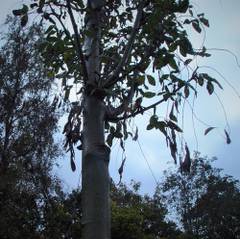
Laburnum anagyroides is a small upright deciduous tree in the family Fabaceae native to central and southern Europe, reaching 15-25 feet (4.5-7.5 m) tall and 10-20 feet (3-6 m) wide with an upright vase-shaped habit and smooth olive-green bark on young stems. Leaves are trifoliate, alternate, and composed of three oval softly hairy leaflets 1-3 inches (2.5-7 cm) long that are gray-green above. Pendant golden-yellow pea-shaped flowers 0.75 inch (2 cm) long open in drooping terminal racemes 8-12 inches (20-30 cm) long during May, and the weight of the flowers pulls the racemes into the hanging curtain display that gives the species its common name and its historical popularity in European gardens. Brown pea-like seed pods 2-3 inches (5-7 cm) long develop through summer and release hard brown seeds in late summer and fall. All parts of the plant are highly toxic to humans and pets because of cytisine, a nicotinic alkaloid concentrated most heavily in the seeds, bark, and roots; ingestion of even a small number of seeds has caused serious poisoning in children with symptoms including vomiting, ataxia, excitement, convulsions, and respiratory failure, and the toxicity is the defining cultivation limitation for the species in landscapes with children or pets. The species is short-lived at 20-30 years regardless of care and does not tolerate hot humid summers — performance in the southeastern US and other continental warm-summer climates is poor and cultivation is concentrated in cool-summer regions including the Pacific Northwest, northern New England, the upper Midwest, the British Isles, and northern Europe. Nitrogen fixation via root-nodule symbiosis allows the species to establish on poor alkaline soils including chalk. The hybrid Laburnum × watereri 'Vossii' carries longer racemes up to 20 inches (50 cm) and produces fewer seeds than the species, and 'Vossii' is more commonly planted in modern gardens than the species type.
Native Range
Laburnum anagyroides is native to central and southern Europe, from France east through the Alps to the Balkans, where it grows on calcareous mountain slopes, open woodland, and dry rocky ground at low to mid elevations. The species has been in cultivation across Europe since at least the 16th century and is the parent of the more commonly planted hybrid L. × watereri.Suggested Uses
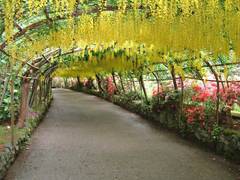
Planted as a small specimen tree, in small formal gardens, and trained over arched pergolas in the classical 'laburnum walk' form at 10-20 foot (3-6 m) spacing in cool-summer zones 5-9. The pendant golden raceme display in May is the historical basis for the laburnum walk — an arched tunnel with the flowering racemes hanging down inside — which was popularized in English estate gardens during the 19th century and remains a signature planting style at Bodnant Garden in Wales and other historic European gardens. The hybrid L. × watereri 'Vossii' is substituted for the species in most modern plantings because of its longer racemes and reduced seed set. Not suited to landscapes with unsupervised access by children or pets where toxic seeds fall beneath the tree, continental warm-summer climates including the southeastern US where plants perform poorly, sites where long-term landscape investment is wanted because the natural lifespan is only 20-30 years, or positions where heavy fruit pod cleanup is an unwelcome maintenance task.How to Identify
Appearance
Size & Dimensions
Height15' - 25'
Width/Spread10' - 20'
Colors
Bloom Information
Pendant golden-yellow pea-shaped flowers 0.75 inch (2 cm) long open in drooping terminal racemes 8-12 inches (20-30 cm) long during May in zones 5-9, averaging 3 weeks of bloom. Flowers are lightly fragrant and bee-pollinated. Brown pea-like seed pods 2-3 inches (5-7 cm) long develop through summer and contain hard brown seeds that carry the highest concentration of cytisine of any plant part.
Detailed Descriptions
Flower Description
golden-yellow; pea-shaped; borne in pendant racemes 8-12 inches (20-30 cm) long; lightly fragrantFoliage Description
gray-green; trifoliate with three oval softly hairy leaflets 1-3 inches (2.5-7 cm) longGrowing Conditions
Sun Requirements
Requires 4-12 hours of direct sunlight daily
• Full Sun: 6+ hours of direct sunlight
• Partial Shade: 3-6 hours of direct sunlight
• Full Shade: Less than 3 hours of direct sunlight
Care & Maintenance
Care Guide
Plant in well-drained soil with a pH of 5.5-7.5 in full sun to part shade; tolerated soil types include loam, clay, chalk, and sand. The species tolerates alkaline chalk soils because it fixes its own nitrogen via root-nodule symbiosis and does not depend on high soil fertility for establishment. Water weekly through the first 1-2 growing seasons; established trees are drought-tolerant. All parts of the plant contain cytisine, a nicotinic alkaloid concentrated most heavily in the seeds, bark, and roots — ingestion has caused serious poisoning and occasional fatalities in children, with symptoms including vomiting, ataxia, excitement, convulsions, and respiratory failure, and the species is unsuited to landscapes with unsupervised access by children or pets where the seed pods and fallen seeds present an ingestion hazard. The species does not tolerate hot humid summers and performs poorly in the southeastern US and similar continental warm-summer climates; cultivation is concentrated in cool-summer regions. Pruning is done after flowering in May and June. The natural lifespan is short at 20-30 years even under good care.Pruning
Pruning is done after flowering in May and June. Dead, damaged, and crossing branches are removed at the branch collar. Developing seed pods are removed during pruning where feasible to reduce the quantity of toxic seeds that fall beneath the tree and to redirect plant energy away from seed production, which modestly extends the natural lifespan of the tree. On specimens trained over arched pergolas (the classical 'laburnum walk' form associated with English estate gardens) the new flowering shoots are tied into the supporting framework during the summer pruning visit to carry the pendant raceme display on the underside of the arch the following spring.Pruning Schedule
Prune: May–June
late spring