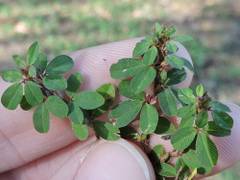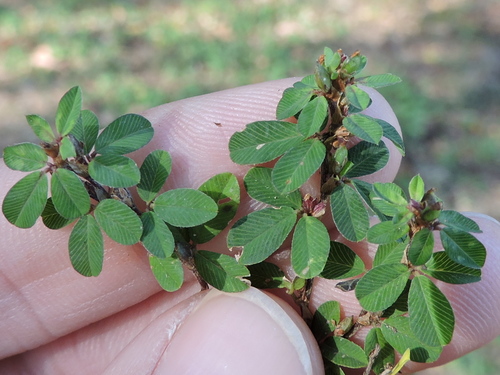
Kummerowia, Genus, spp., Multiple species,
- Genus
- Multiple species
Eastern Asia (China, Korea, Japan); naturalised in eastern USA
SunFull Sun – Part Shade
Overview
Kummerowia is a genus of two annual legumes in the family Fabaceae, native to eastern Asia and widely naturalised in the southeastern United States. Plants are low and wiry, branching from the base into spreading or ascending stems 4-18 inches (10-45 cm) long that form loose, ground-hugging mats. The leaves are divided into three small oval leaflets 0.2-0.8 inch (5-20 mm) long, marked with parallel veins and bristly margins. Tiny pea-shaped flowers 0.2 inch (5 mm) long appear singly or in small clusters in the leaf axils from midsummer into autumn, in pink to pink-purple, and are often self-pollinating. Small single-seeded pods follow. Like other legumes, the plants fix nitrogen through root nodules and improve thin soils. Kummerowia grows on poor, compacted, or eroded ground, but it is a warm-season annual that dies with the first frost and reseeds for the next year. Where naturalised it can spread into lawns, roadsides, and disturbed open ground.
Native Range
Kummerowia is native to eastern Asia, including China, Korea, and Japan. Both species were introduced to North America for forage and erosion control and are now naturalised across much of the eastern and central United States, where they grow on roadsides, fields, and disturbed soils.Suggested Uses
Kummerowia is used as a warm-season forage, a cover crop, and a soil-improving plant on poor or eroded ground, and for erosion control on banks. Its nitrogen fixation and tolerance of thin soils suit reclamation and pasture plantings. The ready self-seeding makes it unsuited to tidy lawns and small ornamental beds, where it can become weedy.How to Identify
Appearance
Size & Dimensions
Height4" - 1'6"
Width/Spread6" - 1'6"
Bloom Information
Detailed Descriptions
Flower Description
pink to pink-purpleFoliage Description
greenGrowing Conditions
Sun Requirements
Requires 5-12 hours of direct sunlight daily
• Full Sun: 6+ hours of direct sunlight
• Partial Shade: 3-6 hours of direct sunlight
• Full Shade: Less than 3 hours of direct sunlight
Water & Climate
Water Needs
Drought Tolerance
Drought tolerant when established
Care & Maintenance
Care Guide
Plants grow in full sun to light shade on a wide range of soils, including poor, dry, acidic, or compacted ground that few crops tolerate. As nitrogen-fixing legumes they need no added nitrogen and can improve depleted soil. Growth is fastest in warm weather, and plants complete their cycle in a single season, dying at first frost and regrowing from self-sown seed. Little care is needed once seedlings establish, and overwatering or rich soil gives lush leaf growth with less seed. In lawns and gardens the self-seeding habit can make it weedy. No winter protection applies, since the plants are annual.Pruning
No pruning is required for these low annuals. Mowing or trimming in late summer before seed sets can limit unwanted spread. Plants are otherwise left to complete their single-season cycle.Toxicity
Non-toxicPlanting Guide
Planting Methods & Timing
Planting Method
direct sow
Direct Sow Timing
spring after the last frost
Days to Maturity
60–90 days
Plant Spacing
6 inches