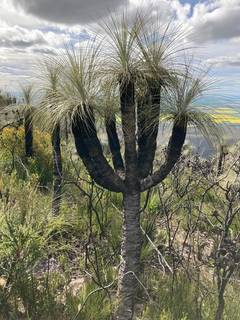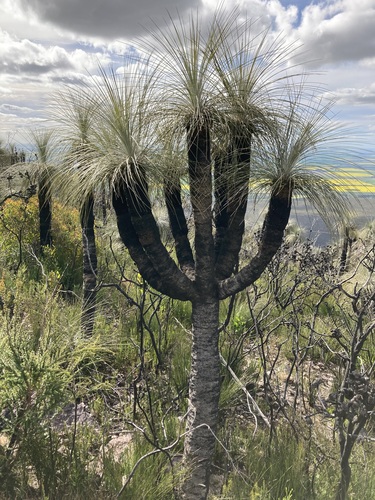
Kingia, Genus, spp., Multiple species,
- Genus
- Multiple species
Overview
Kingia is a genus represented by the single species Kingia australis, a very slow-growing trunked plant endemic to southwestern Western Australia. Over many decades it builds a stout, fibrous trunk 3-13 feet (1-4 m) tall, clothed in the persistent bases of old leaves and topped by a dense crown of slender, blue-green to grey-green leaves 16-35 inches (40-90 cm) long that arch outward in a rounded mop. Mature plants produce a ring of cylindrical, drumstick-like flower heads on stalks 12-24 inches (30-60 cm) long that rise around the edge of the crown, each head packed with small cream to white flowers. Flowering often follows summer bushfires. The trunk grows only a fraction of an inch (a few millimetres) per year, so large specimens are centuries old. Kingia resembles the grass-trees (Xanthorrhoea) but is unrelated and differs in its stalked, ringed flower heads. It needs sharp drainage and a Mediterranean climate, is intolerant of root disturbance, and transplants poorly once established.
Native Range
Kingia is endemic to the southwest of Western Australia, where K. australis grows in jarrah and marri forest, woodland, and sandy heath on well-drained soils. Its range lies within a winter-rainfall, summer-dry Mediterranean climate.Suggested Uses
Kingia is used as a long-lived feature plant in native, dry-climate, and collector gardens, and in containers while young. It suits sandy, low-water landscapes within its narrow climate range. Its slow growth and exacting drainage needs make it unsuited to general garden use or cold, wet regions.How to Identify
Appearance
Size & Dimensions
Height3' - 13'
Width/Spread4' - 6'
Colors
Bloom Information
Detailed Descriptions
Flower Description
cream to whiteFoliage Description
blue-green to grey-greenGrowing Conditions
Sun Requirements
Requires 6-12 hours of direct sunlight daily
• Full Sun: 6+ hours of direct sunlight
• Partial Shade: 3-6 hours of direct sunlight
• Full Shade: Less than 3 hours of direct sunlight
Care & Maintenance
Care Guide
Plants grow in full sun on sharply drained sandy or gravelly soils within a warm, winter-wet, summer-dry climate. Establishment is slow, and young plants need measured watering through dry spells without waterlogging, which causes root and trunk rot. Mature plants tolerate extended drought and periodic fire, resprouting from the protected growing point. Phosphorus-rich fertilisers can harm this species, as with many southwestern Australian natives. Growth is measured in millimetres per year, so plants change little within a human timeframe. Cold below about 25F (-4C) damages the foliage.Pruning
No pruning is required. Dead leaves can be left as a natural skirt or removed for appearance, and spent flower stalks can be cut away after the heads dry. Cutting into the single growing point kills the plant, since it cannot branch or resprout from the trunk.Container Growing
Suitable for container growing
Minimum container size: 7 gallons