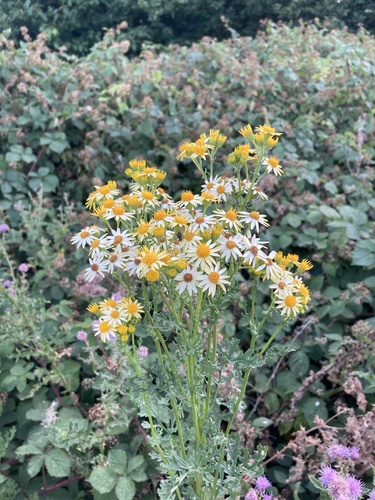
Jacobaea, Genus, vulgaris, Species,
- Genus & species
tansy ragwort
Overview
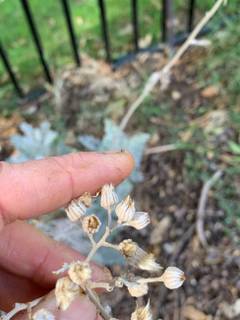
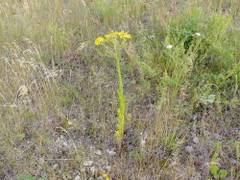
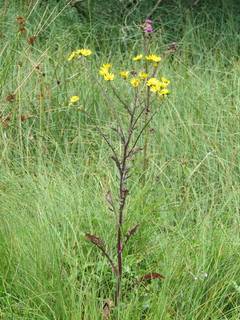
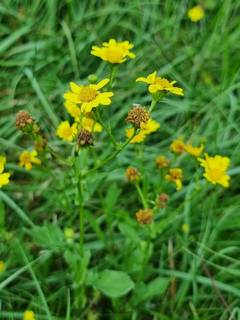
Jacobaea vulgaris (syn. Senecio jacobaea) is a biennial or short-lived perennial in the daisy family (Asteraceae) reaching 18-48 inches (45-120 cm) tall with a 12-24 inch (30-60 cm) spread. First-year plants form a basal rosette of deeply pinnately lobed leaves 3-8 inches (8-20 cm) long with a blunt, rounded terminal lobe larger than the lateral lobes, and irregularly toothed segments. Second-year stems are erect, grooved, branching in the upper half, often reddish-purple at the base. Stem leaves are progressively smaller upward, deeply lobed, clasping. Flower heads are 0.6-0.8 inch (15-20 mm) across, with typically 13 yellow ray florets (occasionally 12-14) surrounding a dense disc of yellow tubular florets, borne in flat-topped to slightly domed corymbs. A single plant produces 50,000-150,000 seeds, of which pappus-bearing disc achenes travel long distances by wind and ray achenes lack a pappus and fall near the parent. Seeds remain viable in soil for 4-10 years. All parts contain pyrrolizidine alkaloids (PAs) — principally jacobine, jaconine, and jacoline — that cause progressive, irreversible liver damage (hepatic veno-occlusive disease) in horses and cattle. Livestock losses from tansy ragwort poisoning have been a substantial agricultural concern in the Pacific Northwest. J. vulgaris is listed as a Class B noxious weed in Washington State.
Native Range
Jacobaea vulgaris is native to Europe and western Asia, occurring in grasslands, pastures, roadsides, and waste ground from sea level to approximately 5,000 feet (1,500 m). Introduced to North America, likely as a contaminant of ballast and animal feed, the species is widely naturalized in the Pacific Northwest, particularly west of the Cascades, where the maritime climate closely matches its native range.Suggested Uses
Used in livestock toxicology and noxious weed management training as a primary teaching case for pyrrolizidine alkaloid poisoning. The cinnabar moth biological control program is a standard case study in integrated weed management. Studied in plant secondary chemistry, liver toxicology, and seed bank ecology. Serves as the larval host plant for the cinnabar moth, whose black-and-yellow striped caterpillars are a familiar sight on ragwort plants in the Pacific Northwest. J. vulgaris is a regulated Class B noxious weed in Washington State and is not planted horticulturally.How to Identify
Appearance
Size & Dimensions
Height1'6" - 4'
Width/Spread1' - 2'
Bloom Information
Flowers appear June through September. Individual heads bloom for 5-7 days. Flat-topped corymbs produce heads over 4-6 weeks. In the Pacific Northwest, peak bloom occurs in July through August. Both wind-dispersed (pappus-bearing disc achenes) and gravity-dispersed (pappus-lacking ray achenes) seeds are produced. Flowers are pollinated by a wide range of insects.
Detailed Descriptions
Flower Description
Yellow ray florets (typically 13) around a yellow disc; flat-topped to domed corymbsFoliage Description
Dark green above, lighter beneath, deeply pinnately lobed with a blunt terminal lobe and irregularly toothed segments; basal leaves lyrateGrowing Conditions
Sun Requirements
Requires 6-10 hours of direct sunlight daily
• Full Sun: 6+ hours of direct sunlight
• Partial Shade: 3-6 hours of direct sunlight
• Full Shade: Less than 3 hours of direct sunlight