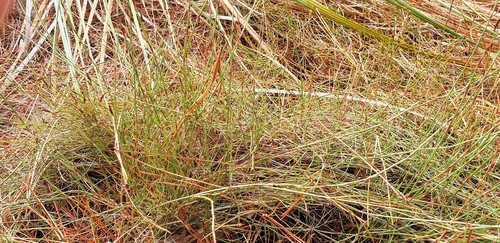
Hypolaena, Genus, spp., Multiple species,
- Genus
- Multiple species
Australia (southwest Western Australia and southeastern Australia)
Overview
Hypolaena is a genus of roughly ten species of rhizomatous, rush-like perennials in the family Restionaceae. The plants form tufts or spreading colonies of slender, wiry stems (culms) that carry out photosynthesis in place of true leaves, which are reduced to brown papery sheaths along the stems. Culms are cylindrical, green to grey-green, and range across the genus from about 12 to 36 inches (30 to 90 cm) tall, with some populations reaching 48 inches (120 cm). Plants are dioecious, so male and female flowers occur on separate individuals; the flowers are small, wind-pollinated, and grouped into brown spikelets near the stem tips. Female plants develop small dry nut-like fruits after pollination. The genus is restricted to Australia, with the greatest concentration of species in the southwest of Western Australia and outliers in southeastern Australia, where the plants grow in seasonally waterlogged sandplains, heath, and swamp margins. Hypolaena spreads by underground rhizomes, forming patches over time. Because the plants are dioecious, a single isolated clump will not set seed without a plant of the opposite sex nearby, and the wiry texture and muted colouring give little seasonal change. The reduced leaves and tough culms suit the genus to nutrient-poor sandy soils and periodic seasonal flooding.
Native Range
Hypolaena is endemic to Australia. The genus is most diverse in the southwest of Western Australia, with additional species in southeastern Australia, including parts of Victoria, New South Wales, and Tasmania.Suggested Uses
Hypolaena is used in native and water-wise gardens, in bog and pond-margin plantings, and in revegetation of seasonally wet sandy sites. The wiry evergreen culms add vertical texture in mixed plantings and combine with other Australian heath species. Cut culms are sometimes used in dried arrangements.How to Identify
Appearance
Size & Dimensions
Height1' - 3'
Width/Spread1' - 3'
Colors
Bloom Information
Flowering occurs mainly in spring, typically September to November in the native Southern Hemisphere range. The flowers are small, brown, and wind-pollinated, clustered into spikelets, and they have no petals and little visual change through the season. Female plants ripen small dry fruits over the following weeks.
Detailed Descriptions
Foliage Description
green to grey-greenGrowing Conditions
Sun Requirements
Requires 6-10 hours of direct sunlight daily
• Full Sun: 6+ hours of direct sunlight
• Partial Shade: 3-6 hours of direct sunlight
• Full Shade: Less than 3 hours of direct sunlight
Care & Maintenance
Care Guide
Hypolaena grows in full sun in sandy, low-nutrient soils that stay moist or seasonally waterlogged in winter and spring. The genus tolerates poor drainage better than many ornamentals and withstands periodic flooding, while established plants also endure summer drying. Most species are frost-tender and suited to mild, frost-free or near-frost-free climates roughly equivalent to USDA zones 9 to 10. Like many Australian natives the plants are phosphorus-sensitive, growing in soils low in added fertiliser, and high-phosphorus feeds can damage the roots. Propagation is by division of rhizomes or by seed, with seed often germinating after smoke or heat treatment that mimics natural fire cues.Pruning
Old or damaged culms can be cut back at the base in late winter before new growth begins. Plants need no regular pruning and regenerate from the rhizome after cutting or fire. Removing spent culms keeps clumps neat but is not required for health.Container Growing
Suitable for container growing
Minimum container size: 3 gallons
