Hydrilla, Genus, verticillata, Species,
- Genus & species
hydrilla
Old World tropics and subtropics (Asia, Africa, Australia)
Overview
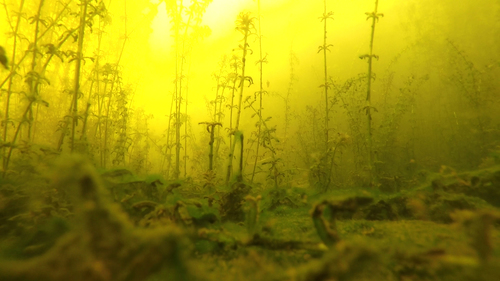
Hydrilla verticillata is a submerged aquatic perennial in the family Hydrocharitaceae reaching stem lengths of 1-25 feet (0.3-7.5 m) in water depths of 1-20 feet (0.3-6 m). The species ranks among the worst aquatic invasive plants globally and is listed as a federal noxious weed in the United States. Stems are slender and branching, rooted in the substrate, growing vertically and then forming dense mats at the water surface. Leaves are small lance-shaped 0.2-0.8 inch (5-20 mm) long and 0.04-0.16 inch (1-4 mm) wide, with serrate (toothed) margins visible to the naked eye, borne in whorls of 3-8 (usually 5) along the stem. A small midrib spine is present on the leaf underside. The species reproduces by four mechanisms: stem fragmentation, tubers (subterranean), turions (axillary buds on the stem), and seed. Tubers are produced on the ends of underground stolons at 2-12 inches (5-30 cm) depth, 0.2-0.4 inch (5-10 mm) long, light brown, and remain viable in sediment for 4-10 years. Turions are dark green compact 0.2-0.3 inch (5-8 mm) long, produced in leaf axils, and detach and sink to the sediment to overwinter. Stem fragments as short as 1 inch (2.5 cm) with a single node regenerate. The species is currently absent from the Pacific Northwest but is treated as an imminent threat because it is established in neighboring states.
Native Range
Hydrilla verticillata is native to the Old World tropics and subtropics, including southeastern Asia, India, Africa, and Australia. Introduced to North America through the aquarium trade in the 1950s-1960s. Established in the southeastern United States, California, and scattered locations across temperate North America. Currently absent from the Pacific Northwest but listed as a priority early-detection species.Suggested Uses
Used as a priority early-detection species in Pacific Northwest aquatic invasive-species training. Studied in aquatic weed biology as a model for multi-mechanism vegetative persistence (tubers, turions, fragmentation). Included in aquatic plant identification courses for teaching differentiation from Egeria densa and Elodea canadensis. The economic impact of hydrilla infestations in Florida and other southeastern states is a primary case study in invasive-species economics.How to Identify
Appearance
Size & Dimensions
Height1' - 25'
Width/Spread1' - 5'
Bloom Information
Tiny white to translucent three-petaled flowers produced at the water surface on threadlike stalks, borne July through September. Both monoecious (one biotype) and dioecious (another biotype) forms occur in North America. Seed production is limited in North America; reproduction is overwhelmingly vegetative via tubers, turions, and fragmentation.
Detailed Descriptions
Flower Description
White to translucent; tiny three-petaled flowers produced at the water surface on threadlike stalks; July-SeptemberFoliage Description
Green; small lance-shaped 0.2-0.8 inch (5-20 mm); serrate margins with teeth visible to the naked eye; borne in whorls of 3-8 (usually 5) along the stem; midrib spine on the underside; evergreenGrowing Conditions
Sun Requirements
Requires 3-10 hours of direct sunlight daily
• Full Sun: 6+ hours of direct sunlight
• Partial Shade: 3-6 hours of direct sunlight
• Full Shade: Less than 3 hours of direct sunlight