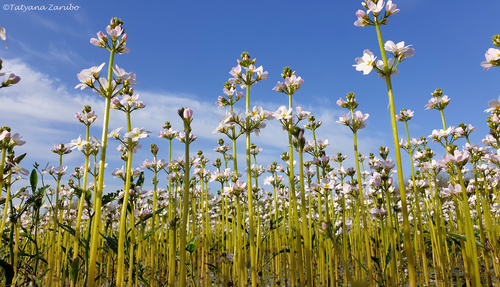
Hottonia, Genus, spp., Multiple species,
- Genus
- Multiple species
Temperate Europe, western Asia, and eastern North America
Overview
Hottonia is a genus of two aquatic perennials in the primrose family, Primulaceae: H. palustris, water violet, of Europe and western Asia, and H. inflata, featherfoil, of eastern North America. Both root in the mud of still or slow-moving water and carry whorls of submerged, finely divided, feather-like leaves that give the plants a soft, plume-like underwater form. In late spring and summer a hollow flower stem rises above the surface bearing whorls of flowers: pale lilac with a yellow eye in H. palustris, and small white flowers on the swollen, inflated stalks of H. inflata. Below water the foliage forms dense, bright green masses that shelter aquatic insects and fish fry. The plants overwinter as resting buds on the pond floor and regrow in spring. Hottonia needs clean, cool, still to gently moving water and clear light, and it declines in turbid, nutrient-loaded, or shaded ponds. H. inflata is uncommon and of conservation concern through parts of its range.
Native Range
Native to fresh, still or slow-flowing waters of the cool-temperate northern hemisphere; H. palustris across Europe and western Asia, H. inflata in eastern North America.Suggested Uses
Grown in wildlife ponds, bog gardens, and the margins of natural swimming ponds as a submerged oxygenating plant. The summer flower spikes rise above still water in mixed aquatic plantings. The feathery foliage gives cover for fish fry and aquatic insects.How to Identify
Appearance
Size & Dimensions
Height8" - 1'4"
Width/Spread1' - 2'
Bloom Information
Detailed Descriptions
Flower Description
Pale lilac to white with yellow eyeFoliage Description
Bright greenGrowing Conditions
Sun Requirements
Requires 4-8 hours of direct sunlight daily
• Full Sun: 6+ hours of direct sunlight
• Partial Shade: 3-6 hours of direct sunlight
• Full Shade: Less than 3 hours of direct sunlight
Care & Maintenance
Care Guide
Hottonia grows rooted in soft mud in full sun to light shade in ponds, ditches, and slow streams 4-24 inches (10-60 cm) deep. It needs clean, cool, oxygen-rich water and clears poorly in stagnant or heavily fertilised conditions. Slightly acidic to neutral, low-nutrient water suits it, and algae from excess nutrients shade out the submerged leaves. Plants are fully cold-hardy and survive winter as turions on the pond bed. No feeding is needed, as nutrients come from the water and sediment. It is grown from turions, stem fragments, or seed pressed into wet mud.Pruning
Pruning is limited to removing spent flower stems after blooming and thinning crowded growth in summer. Excess stems can be pulled out to keep open water. Decaying foliage is cleared in autumn so it does not foul the water.Container Growing
Suitable for container growing
Minimum container size: 3 gallons
