Overview
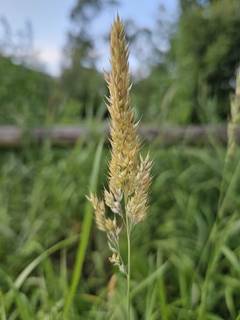
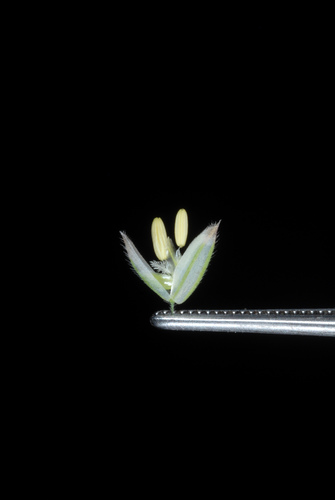
Holcus lanatus is a tufted short-lived perennial grass (sometimes behaving as a winter annual) reaching 12-36 inches (30-90 cm) tall and 8-18 inches (20-45 cm) wide. The defining feature is the soft velvety pubescence covering all parts: leaves, sheaths, and stems are densely clothed in short soft hairs that give the foliage a gray-green cast and a plush texture when the blade is stroked, the source of the common name velvet-grass. Leaf blades are 2-8 inches (5-20 cm) long and 0.2-0.5 inch (5-12 mm) wide, flat, with a membranous ligule 0.04-0.12 inch (1-3 mm) long. The inflorescence is a compact ovoid to oblong panicle 2-6 inches (5-15 cm) long, whitish to pale pink when fresh and becoming tan at maturity. Spikelets are two-flowered, and the upper floret bears a short hooked awn enclosed within the glumes. A single plant produces 1,000-5,000 seeds that germinate readily in fall and spring. Hardy in USDA zones 4-9 (-30°F / -34°C). The species is common across the Pacific Northwest in moist meadows, pastures, roadsides, and disturbed sites. Palatability to livestock is low because of the hairy texture and low nutritional quality, which allows velvet-grass to persist in grazed pastures as more palatable species are preferentially grazed around it.
Native Range
Holcus lanatus is native to Europe, western Asia, and northern Africa, where it grows in meadows, pastures, roadsides, and waste ground from sea level to approximately 6,000 feet (1,800 m). The species has naturalized widely in the Pacific Northwest and is present in every western Oregon and Washington county in moist to wet habitats.Suggested Uses
The species is used in grass identification courses as a tactile identification exercise: the velvety texture allows species-level identification without flowers. Plants are studied in pasture ecology and in introduced grass invasion dynamics. Dried specimens are used in Poaceae morphology exercises for spikelet structure, ligule types, and awn variation.How to Identify
Appearance
Size & Dimensions
Height1' - 3'
Width/Spread8" - 1'6"
Bloom Information
Compact ovoid to oblong panicles 2-6 inches (5-15 cm) long emerge from May through July over a 2-3 week period, starting whitish to pale pink and turning tan at maturity. Plants are wind-pollinated. In the Pacific Northwest, peak panicle emergence occurs in June. Seeds mature by July and the compact panicle retains seed for 2-4 weeks after maturity before shattering.
Detailed Descriptions
Flower Description
Whitish to pale pink turning tan at maturity; carried in compact ovoid to oblong panicles 2-6 inches (5-15 cm) longFoliage Description
Gray-green; 2-8 inches (5-20 cm) long, 0.2-0.5 inch (5-12 mm) wide; flat; densely clothed on both surfaces with short soft hairs producing a plush velvet-like texture when the blade is strokedGrowing Conditions
Sun Requirements
Requires 4-10 hours of direct sunlight daily
• Full Sun: 6+ hours of direct sunlight
• Partial Shade: 3-6 hours of direct sunlight
• Full Shade: Less than 3 hours of direct sunlight