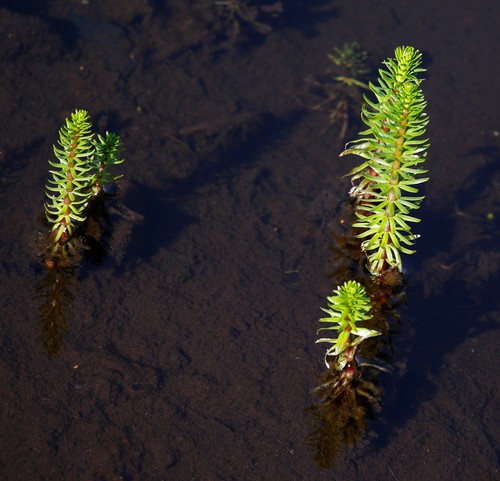
Hippuris, Genus, spp., Multiple species,
- Genus
- Multiple species
mares tail
Northern Hemisphere wetlands, with some southern temperate occurrences
Overview
Hippuris is a genus of about four aquatic perennials, the mare's tails, in the family Plantaginaceae, found in wetlands across the Northern Hemisphere and parts of the southern temperate zone. Plants spread by creeping rhizomes rooted in mud and send up erect, unbranched stems that stand 8-24 inches (20-60 cm) above the water. Each stem is ringed with whorls of narrow, linear leaves, giving a bottlebrush look that recalls a horsetail, though the two are unrelated. Tiny petalless flowers sit in the upper leaf axils and are wind- or self-pollinated. Submerged forms have longer, softer leaves than the stiff emergent shoots. The common H. vulgaris grows in ponds, ditches, slow streams, and marsh margins, often in shallow, still water. Plants spread quickly by rhizome and can colonize a small pond, so they need room or containment. Top growth dies back over winter in cold climates.
Native Range
Native across the Northern Hemisphere, including Europe, northern and central Asia, and North America, with scattered occurrences in southern South America and New Zealand. Plants grow in shallow fresh water, pond and lake margins, ditches, marshes, and slow streams.Suggested Uses
Used at pond and stream margins, in bog gardens, and in container water features, set 12-24 inches (30-60 cm) apart where spread can be managed. The upright whorled stems give vertical structure at the water edge. Stems and roots give cover and food for fish, insects, and waterfowl.How to Identify
Appearance
Size & Dimensions
Height8" - 2'
Width/Spread1' - 3'
Bloom Information
Tiny flowers appear in summer, generally June to August, set in the angles of the upper leaves. They have no petals and are easy to overlook, relying on wind and water rather than insects. Small dry fruits follow and ripen by late summer.
Detailed Descriptions
Flower Description
greenish, inconspicuousFoliage Description
greenGrowing Conditions
Sun Requirements
Requires 6-12 hours of direct sunlight daily
• Full Sun: 6+ hours of direct sunlight
• Partial Shade: 3-6 hours of direct sunlight
• Full Shade: Less than 3 hours of direct sunlight
Care & Maintenance
Care Guide
Mare's tail grows in full sun to part shade in shallow fresh water or permanently saturated mud at pond and stream edges. It roots in heavy, mucky soil and tolerates water a few inches to about a foot deep. The plants are very cold hardy, surviving to about USDA zone 3, and die back to the rhizomes in winter. Spread is rapid through creeping rhizomes, so plants are usually grown in containers or contained beds in small ponds. Still or slow-moving water suits them better than fast current. Crowded growth is thinned by lifting sections in spring.Pruning
Maintenance is mostly thinning to keep the spreading stems in check. Excess growth is lifted and removed during the growing season. Dead top growth can be cleared in late autumn or left as cover over winter.Container Growing
Suitable for container growing
Minimum container size: 2 gallons
