Image 1 of 13
1 / 13
© No machine-readable author provided. Svdmolen assumed (based on copyright claims)., some rights reserved (CC-BY-SA) · Wikimedia Commons
Hippophae, Genus, rhamnoides, Species,
- Genus & species
Sea-buckthorn
Overview
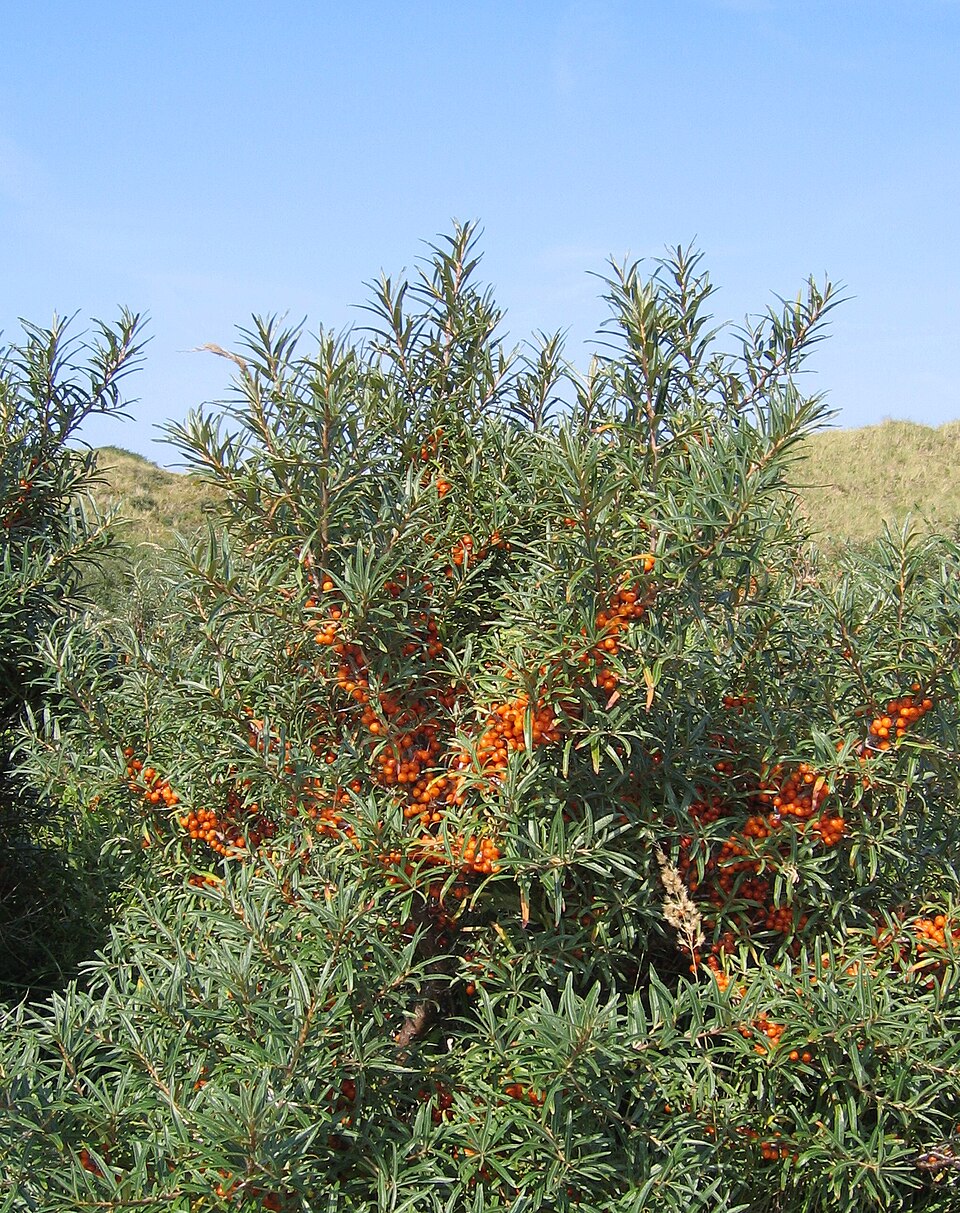
Hippophae rhamnoides is a thorny, suckering deciduous shrub or small tree of the oleaster family, reaching 6-20 feet (2-6 m) tall with stiff, spiny branches and narrow, silvery leaves. The leaves are linear, 1.5-3 inches (4-8 cm) long, grey-green above and silver-scaled beneath, giving the whole plant a grey cast. It is dioecious, with small, wind-pollinated yellow-green flowers opening on bare stems in March and April before the leaves. Female plants bear dense clusters of bright orange berries about 0.3 inch (6-8 mm) across that ripen in late summer and persist into winter; the acidic, vitamin-rich fruit is used for juices and preserves. The roots carry nitrogen-fixing bacteria, letting it grow on poor, sandy, and saline soils. It grows on coastal dunes, cliffs, shingle, and riverbanks, spreading vigorously by root suckers to form dense, impenetrable thickets that can crowd out other vegetation. Native across Europe and temperate Asia, it is planted for dune stabilization and shelter. Sharp spines and rampant suckering make it difficult to manage in small spaces.
Native Range
Hippophae rhamnoides is native across Europe and temperate Asia, from the Atlantic coasts to China and the Himalayas. In the British Isles it grows wild on east-coast dunes and has been widely planted elsewhere.Suggested Uses
Planted for dune and slope stabilization, coastal shelter belts, and wildlife hedging, where the dense spiny growth gives nesting cover and the berries feed birds. The vitamin-rich fruit is harvested for juices, syrups, and preserves.How to Identify
Appearance
Size & Dimensions
Height6' - 20'
Width/Spread6' - 15'
Colors
Bloom Information
Small yellow-green flowers open on bare stems in March and April, before the leaves expand. The wind-pollinated flowers are inconspicuous, with males and females on separate plants. Female plants develop orange berries that ripen from August and hold on the branches into winter.
Detailed Descriptions
Foliage Description
silvery grey-greenGrowing Conditions
Sun Requirements
Requires 6-12 hours of direct sunlight daily
• Full Sun: 6+ hours of direct sunlight
• Partial Shade: 3-6 hours of direct sunlight
• Full Shade: Less than 3 hours of direct sunlight
Care & Maintenance
Care Guide
Grows in full sun on free-draining sandy, stony, or saline soils and fixes its own nitrogen, so it needs no feeding. A soil pH from 6.0 to 8.0 suits it, and it tolerates drought, salt, and strong coastal wind once established. Both male and female plants are needed for berries, with one male serving several females. It suckers strongly and can spread well beyond its planting position, so root barriers or regular removal of suckers are used to contain it. It grows poorly on wet, shaded, or rich sites. It is hardy to USDA zone 3.Pruning
Light pruning to shape is carried out in late summer after the berries colour, as the plant bleeds sap if cut in spring. Suckers are removed through the season to limit spread. Old, congested stems can be thinned at the base.Pruning Schedule
summer