Image 1 of 10
1 / 10
© Photographs by Gnangarra...commons.wikimedia.org, some rights reserved (CC-BY) · Wikimedia Commons
Hardenbergia, Genus, comptoniana, Species,
- Genus & species
native wisteria
Overview
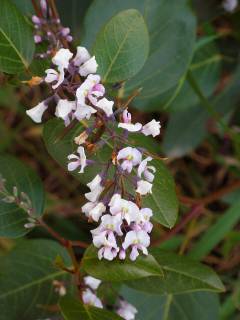
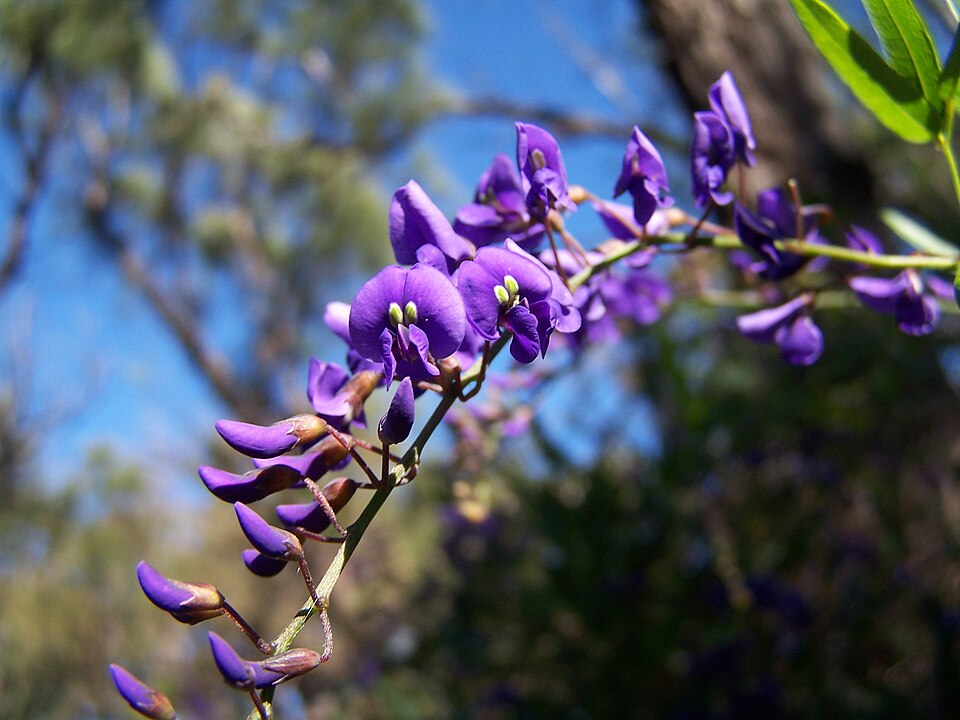
Hardenbergia comptoniana is an evergreen twining climber growing 6-13 feet (2-4 m) high with slender, wiry stems that twist around supports. Leaves are divided into three leaflets, each lance-shaped to oval, 1.2-3 inches (3-8 cm) long, dark green and leathery, separating it from the single-leaflet leaves of the eastern Hardenbergia violacea. Pea-shaped flowers are about 0.4 inch (10 mm) long, violet to purple with a greenish-yellow spot on the standard petal, and are carried in branched sprays of 20-60 flowers in the leaf axils. Flowering occurs in late winter and spring. Flowers are followed by flat, oblong pods 1-2 inches (2.5-5 cm) long that ripen brown and split to release hard seeds. As a legume, it fixes nitrogen through root nodules. Growth is moderate to fast once established, and stems can climb fences and shrubs or trail as a ground cover. Foliage is held year-round. Without support the plant scrambles and mounds; on a trellis it forms a dense screen. White- and pink-flowered forms occur in cultivation.
Native Range
Native to south-western Western Australia, from north of Geraldton south to Albany. Grows in jarrah and tuart forest, woodland, and coastal scrub, climbing through shrubs and small trees on sandy and gravelly soils.Suggested Uses
Grown on trellises, fences, pergolas, and embankments, and as a trailing ground cover, spaced 5-10 feet (1.5-3 m) apart. Used to screen structures and to cover banks for erosion control. Grows in large containers of at least 5 gallons (19 L) with a support and free-draining mix.How to Identify
Appearance
Size & Dimensions
Height6' - 13'
Width/Spread5' - 10'
Bloom Information
Detailed Descriptions
Flower Description
violet to purpleFoliage Description
dark greenGrowing Conditions
Sun Requirements
Requires 4-9 hours of direct sunlight daily
• Full Sun: 6+ hours of direct sunlight
• Partial Shade: 3-6 hours of direct sunlight
• Full Shade: Less than 3 hours of direct sunlight
Care & Maintenance
Care Guide
Grows in full sun to part shade on free-draining sandy or gravelly soils and tolerates drought and short frosts once established. Watering through the first summer aids establishment, after which little supplementary water is needed. As a legume it fixes its own nitrogen; phosphate fertilisers can damage the roots. It twines and can smother small shrubs if left unmanaged, so it is grown on a trellis or open fence. Few pests trouble it, though it can be short-lived, persisting around 8-12 years. Hard frost damages soft new growth.Pruning
Pruning after flowering controls size and shape and keeps the plant from smothering nearby plants. It tolerates moderately hard pruning and reshoots from older wood. Cutting back leggy growth promotes denser foliage and more flowering shoots.Pruning Schedule
Prune: October–November
spring
Container Growing
Suitable for container growing
Minimum container size: 5 gallons