Image 1 of 14
1 / 14
Plant Reference
Hakonechloa, Genus, macra, Species,
- Genus & species
Hakone grass
Japan — endemic to steep moist rocky slopes and cliff faces in montane woodland on the island of Honshu, particularly the Hakone, Tanzawa, and Nikko mountain regions
Overview
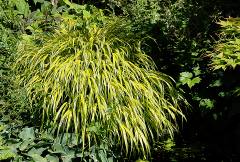
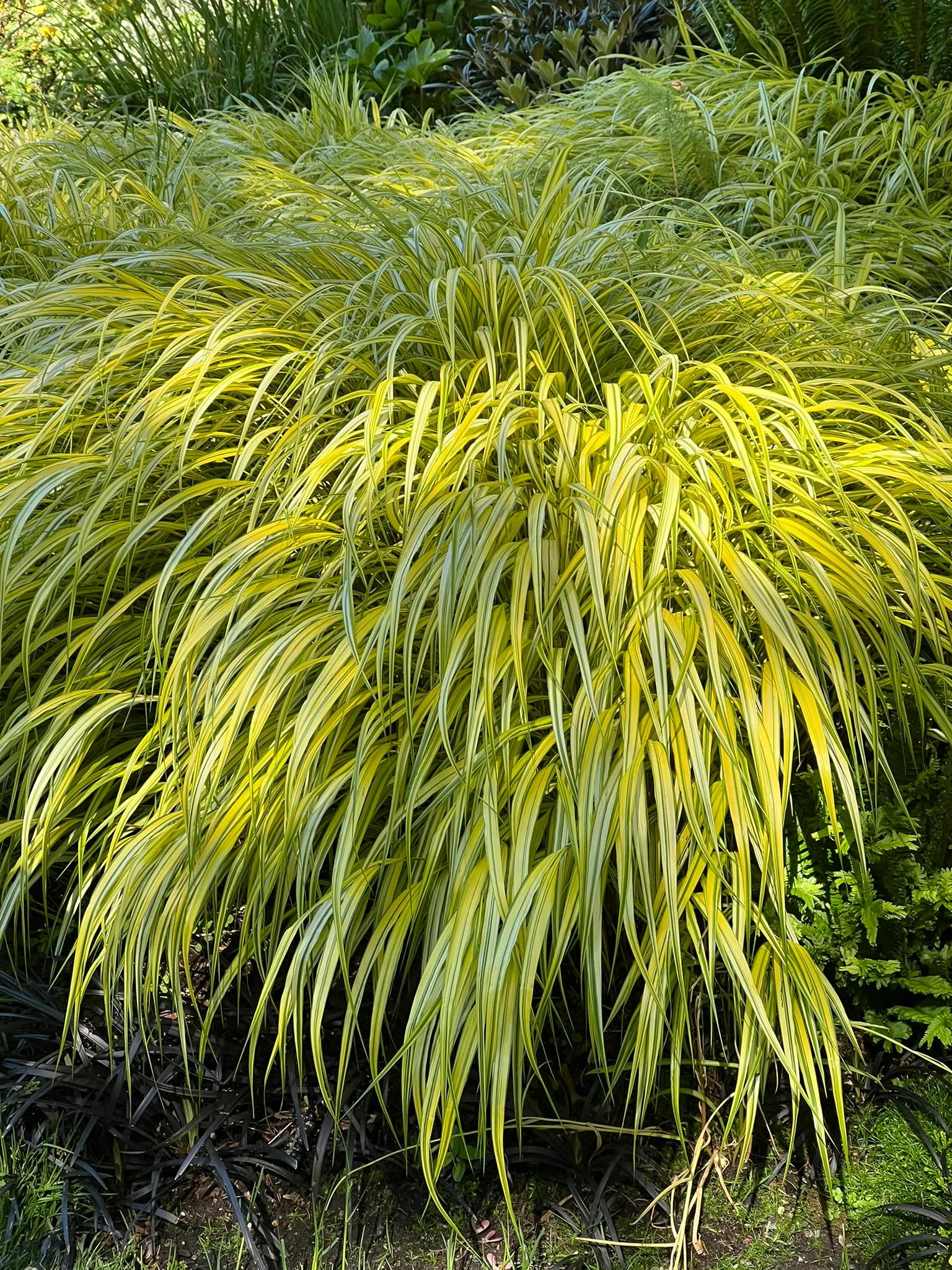
Hakonechloa macra is a warm-season deciduous bunchgrass in the family Poaceae and the sole species in the monotypic genus Hakonechloa, growing 12–18 inches (30–45 cm) tall and 18–24 inches (45–60 cm) wide in dense mounds of slender arching bamboo-like leaves 8–12 inches (20–30 cm) long. The leaves flow uniformly in one direction down the slope of the mound, producing a cascading waterfall-like silhouette that is the main ornamental feature of the species. The species type carries bright green foliage, and two variegated cultivars are widely planted: 'Aureola' carries gold-and-green striped leaves that take on pink-tinged tones in cool fall weather and was named perennial of the year by the Perennial Plant Association in 2009, and 'All Gold' carries entirely golden-yellow leaves that brighten shaded positions. Delicate open panicles of pale green to tan spikelets emerge above the foliage in August and September but are secondary to the foliage display and often go unnoticed. Fall foliage transitions through warm gold, copper, pink, and red tones across October and November before dying back for winter dormancy. The species is endemic to steep moist rocky slopes and cliff faces in montane woodland on the island of Honshu, Japan, particularly the Hakone, Tanzawa, and Nikko mountain regions, from which the common name Hakone grass derives. As a warm-season grass, H. macra is slow to emerge in spring — new growth begins only when soil temperatures reach 60 °F (15 °C), which can delay leaf emergence until late April or even May in cooler climates, and gardeners sometimes mistake the delayed emergence for plant death during the first spring after planting. Limitation: the species is intolerant of drought and calls for consistent soil moisture through the growing season, and hot afternoon sun in USDA zones 7 and 8 scorches the leaf tips and dulls the gold coloration of the variegated cultivars. The variegated cultivars develop the most vivid color in bright indirect light rather than in deep shade or in full sun; deep shade dulls the gold tones to a muted yellow-green, and full sun bleaches the variegated leaves and produces scorch on the leaf margins. The slow growth rate of the species combined with the slow rhizomatous spread produces a compact non-aggressive clump that takes 2–3 years to reach full size and calls for division only every 3–5 years when the crown becomes congested.
Native Range
Endemic to Japan, growing on steep moist rocky slopes and cliff faces in montane woodland on the island of Honshu, particularly the Hakone mountains southwest of Tokyo (from which the common name derives), the Tanzawa mountains, and the Nikko mountain region to the north. Grows in the dappled shade of deciduous forest canopies on humus-rich substrates at middle elevations where cool summer temperatures and consistent moisture from summer rainfall suit the growth cycle of the species.Suggested Uses
Used in shade borders, woodland garden edges, Japanese-style gardens, raised bed and retaining wall edges, container plantings of at least 3 gallons (11 L), and along garden path margins at 18–24 inch (45–60 cm) spacing. The cascading mounds drape gracefully over the edges of raised beds, retaining walls, and container rims, which makes the species a common choice for elevated plantings where the unidirectional flow of the foliage can be displayed to full effect. Companion plantings of Hosta, Astilbe, Epimedium, and woodland ferns pair well with the grass in shade borders. The variegated 'Aureola' and 'All Gold' cultivars are planted in shaded positions to brighten dark corners of the garden. Dry border positions, full sun sites in hot summer climates, and large-scale mass plantings where rapid coverage is the design goal are unsuitable because of the drought sensitivity and the slow growth rate of the species.How to Identify
Appearance
Size & Dimensions
Height1' - 1'6"
Width/Spread1'6" - 2'
Bloom Information
Delicate open panicles of pale green to tan spikelets emerge above the foliage from August through September across a 6-week period. The spikelets carry no ornamental interest beyond a light airy texture above the cascading foliage, and the bloom is secondary to the foliage display that carries the species from spring through fall. No berries or fruit follow because the spikelets are wind-pollinated grass inflorescences. Fall foliage color transition from October through November is a separate seasonal event that follows the end of the flowering period.
Detailed Descriptions
Flower Description
pale green to tan spikelets borne in open airy panicles above the foliage in late summer and early fallFoliage Description
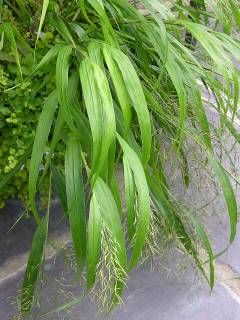
bright green in the species type; slender bamboo-like arching leaves 8-12 inches (20-30 cm) long that flow uniformly in one direction down the slope of the mound; the cultivar 'Aureola' carries gold-and-green variegated leaves and 'All Gold' carries entirely golden-yellow leavesGrowing Conditions
Sun Requirements
Requires 1-5 hours of direct sunlight daily
• Full Sun: 6+ hours of direct sunlight
• Partial Shade: 3-6 hours of direct sunlight
• Full Shade: Less than 3 hours of direct sunlight
Care & Maintenance
Care Guide
Site in partial shade to light shade with 1–5 hours of direct sun per day, with afternoon shade in USDA zones 7 and 8 to reduce leaf scorch during hot summer afternoons. Soil should be moist and humus-rich with a pH of 5.5–7.0, and the species is intolerant of drought and calls for consistent soil moisture through the growing season. The variegated cultivars 'Aureola' and 'All Gold' develop the most vivid color in bright indirect light: deep shade dulls the gold tones to a muted yellow-green and full sun bleaches the leaves and produces scorch on the leaf margins. The species is a warm-season grass and is slow to emerge in spring — new growth begins only when soil temperatures reach 60 °F (15 °C), which can delay leaf emergence until late April or even May in cooler climates. Annual cutback in late winter (February or March) removes the previous year's dead foliage before new growth emerges. Division of congested clumps is done every 3–5 years in spring by digging and splitting the crown into smaller sections. The species is non-toxic and deer-resistant. Hardy in USDA zones 4–9.Pruning
The entire clump is cut to 2–4 inches (5–10 cm) above the crown in late winter or early spring (February or March) before new growth begins. This annual cutback removes the previous-season dead foliage and clears the crown for the new spring emergence. Division of congested clumps is done every 3–5 years in spring by digging the clump, splitting the crown into smaller sections with a sharp spade or knife, and replanting immediately in the original position or at new sites. No other pruning is needed through the growing season because the cascading mound develops naturally and the slow growth rate holds the plant at the intended size without shaping cuts.Pruning Schedule
Prune: February–March
early spring
Container Growing
Suitable for container growing
Minimum container size: 3 gallons