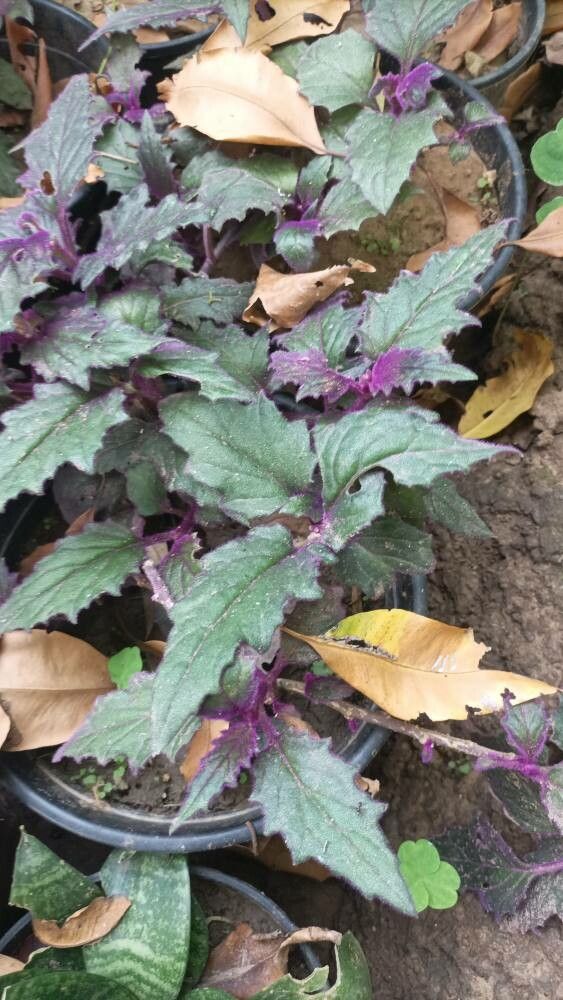
Gynura, Genus, aurantiaca, Species,
- Genus & species
purple passion plant
Java and the Lesser Sunda Islands of Indonesia
Overview
Gynura aurantiaca is an evergreen herbaceous perennial in the Asteraceae (composite) family grown indoors for its dark-green leaves densely covered in short purple hairs that give the plant a velvety violet sheen. Mature plants reach 12–24 inches (30–60 cm) tall and 18–36 inches (45–90 cm) wide as a sprawling-to-trailing shrub on succulent purple-tinged stems. Leaves are alternate, ovate to elliptic with toothed margins, 3–6 inches (7–15 cm) long, with a glossy dark-green ground covered in 0.04–0.06 inch (1–1.5 mm) erect purple to violet hairs that catch and refract light to give the iridescent purple appearance for which the species is grown. Hair density and color intensity peak on new leaves in bright indirect light and fade in low light or with age. Yellow-orange daisy-like flower heads 0.5–0.75 inch (12–18 mm) across open in winter and early spring on terminal stems; the flowers carry an unpleasant odor and are commonly removed by growers before opening. The plant goes leggy and woody-stemmed after 1–2 years and is replaced from cuttings, which root in damp medium within 7–14 days. The species is mildly toxic to pets if ingested in large amounts, with reports of mild gastrointestinal upset; the foliage is not toxic to incidental contact.
Native Range
Gynura aurantiaca is native to tropical Southeast Asia (Indonesia, primarily Java and the Lesser Sunda Islands), growing as an understory perennial in moist secondary forest, forest edges, and disturbed clearings at low to mid elevations. The species has naturalized in tropical regions of Africa, Central America, and the Caribbean and is considered weedy in some warm-climate areas.Suggested Uses
Used as a hanging-basket or trailing shelf-edge specimen indoors, in shaded covered patios in zones 10–11, and in tropical container groupings. Pairs in collections with other warm-growing trailing tropicals (Tradescantia, Hoya, small-leaved Philodendron) at similar light requirements. Spaced one plant per 6–8 inch (15–20 cm) pot, the cultivar reaches mature trailing length within 6–9 months from a rooted cutting.How to Identify
Appearance
Size & Dimensions
Height1' - 2'
Width/Spread1'6" - 3'
Bloom Information
Yellow-orange daisy-like flower heads open from December through March under indoor conditions, with peak bloom in January and February. Each flower head is 0.5–0.75 inch (12–18 mm) across and lasts 5–7 days; the species carries an unpleasant odor for fly pollination, and growers commonly snip developing buds before they open. Bloom is uncommon under low light and on plants younger than 8 months.
Detailed Descriptions
Foliage Description
dark green covered in violet-purple hairsGrowing Conditions
Sun Requirements
Needs bright indirect light. Keep it out of direct sun, which can scorch the leaves.
• Bright indirect light: a bright spot near a window, with no direct sun on the leaves
Care & Maintenance
Care Guide
Bright indirect light of 10,000–25,000 lux is required for the purple hair color to develop; 1–2 hours of direct morning sun is acceptable, but afternoon sun above 30,000 lux burns the leaf tips. Temperatures of 60–80°F (16–27°C) suit the species, with leaf damage at temperatures below 50°F (10°C). A well-drained mix (3 parts standard houseplant mix to 1 part perlite) with a pH of 6.0–7.0 drains within 30 seconds of watering. Watering occurs when the top 1 inch (2.5 cm) of mix dries; constantly wet medium causes stem rot at the soil line and is the main cause of plant loss. Balanced liquid fertilizer at half strength every 3–4 weeks during active growth (April–September) supports new leaf production with intense purple coloration. Plants become leggy and lose hair density after 18–24 months and are replaced from terminal cuttings rooted in damp medium.Pruning
Tip-pruning every 4–6 weeks during active growth maintains a compact branched form and stimulates new purple-haired leaves; cuts are made just above a leaf node using a clean blade. Flower buds are commonly snipped before opening to prevent the unpleasant odor and to redirect energy to leaf production. Old leggy stems can be cut back hard to 2–3 inches (5–8 cm) above the soil in spring, and the cut tips can be propagated as fresh stock to replace declining plants.Pruning Schedule
Prune: March–August
early springlate springsummer
Container Growing
Suitable for container growing
Minimum container size: 1 gallons