Gymnostachys, Genus, spp., Multiple species,
- Genus
- Multiple species
settlers flax
Overview
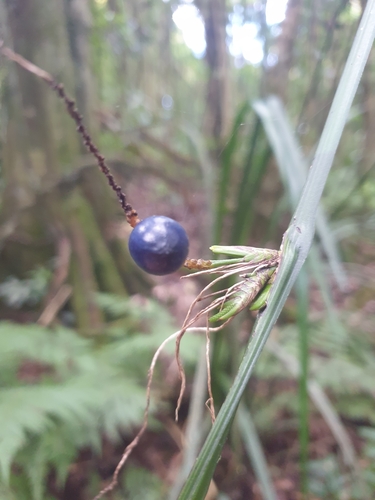
Gymnostachys is a genus in the arum family (Araceae) represented by a single species, G. anceps, known as settlers flax or sword sedge, native to eastern Australia. It is a tufted, evergreen, rhizomatous perennial herb forming dense clumps of long, narrow, sword-shaped leaves 2–5 ft (0.6–1.5 m) long and under 0.8 in (2 cm) wide, leathery and arranged in two ranks. From the clump rise tall, wiry, flattened flowering stems 3–8 ft (0.9–2.4 m) high, branched toward the top and bearing several short, narrow spikes of tiny greenish flowers, without the coloured spathe seen in many aroids. Small fleshy blue to black fruits follow. Plants grow in the understorey of open forest and rainforest margins, on a range of soils. The tough, fibrous leaves were used by early settlers and Aboriginal people for cordage and binding, the source of the common name. The clumping habit and long leaves give it the look of a flax or large sedge rather than a typical arum.
Native Range
Endemic to eastern Australia, from Victoria through New South Wales to Queensland, growing in the understorey of open eucalypt forest, woodland, and rainforest margins, on clay, loam, and sandy soils.Suggested Uses
Grown in native, woodland, and rainforest-style gardens as a clumping foliage plant, and around ponds and in shaded borders for its strappy leaves. It works in mass plantings and as a low-maintenance understorey filler. The long fibrous leaves have a history of use in cordage and weaving.How to Identify
Appearance
Size & Dimensions
Height3' - 8'
Width/Spread2' - 4'
Bloom Information
Flowering occurs mainly in spring and summer, when tall flattened stems rise above the foliage carrying short spikes of small green flowers. The flowers are inconspicuous and lack the coloured spathe of many arum relatives. Small fleshy blue to black fruits follow on the persistent stems.
Detailed Descriptions
Foliage Description
GreenGrowing Conditions
Sun Requirements
Requires 4-8 hours of direct sunlight daily
• Full Sun: 6+ hours of direct sunlight
• Partial Shade: 3-6 hours of direct sunlight
• Full Shade: Less than 3 hours of direct sunlight
Care & Maintenance
Care Guide
Plants grow in part shade to full sun in moist, free-draining soils, tolerating clay and periods of dryness once established. Steady moisture produces lusher clumps, while drier sites give tougher, more compact growth. The species is frost-hardy in mild temperate climates and recovers from light frost. It spreads slowly by short rhizomes to form lasting clumps and needs little feeding. Division of established clumps is the usual means of propagation, alongside seed. Few pests or diseases trouble it.Pruning
No regular pruning is needed. Old, tattered, or frost-marked leaves can be cut to the base to tidy the clump, and spent flower stems removed after fruiting. Clumps can be divided in spring to renew or propagate them.Container Growing
Suitable for container growing
Minimum container size: 5 gallons
